Table of Contents
Email is the most direct and reliable communication channel between a musician and their fans. Unlike social media platforms where algorithms control who sees your content, email delivers your message directly to your subscribers inbox. When you release a new song, announce a tour, or launch a merchandise line, your email list is the audience that will hear about it first and respond most enthusiastically.
Yet most independent musicians neglect email marketing. They focus entirely on social media growth while ignoring the one channel that offers the highest return on investment. Building an email list takes effort, but the payoff is a direct line to your most engaged fans that no algorithm can take away.
Key Takeaways
- Email marketing for musicians has an average ROI of $42 for every $1 spent, outperforming social media advertising by 3-5x
- A lead magnet (free download, exclusive content, or discount) is essential for converting website visitors into email subscribers
- Mailchimp, ConvertKit, and Bandzoogle are the top email service providers for musicians, each with different strengths
- Send newsletters 1-4 times per month with a mix of content: new releases, behind-the-scenes, personal updates, and exclusive offers
- Segment your list by engagement level to send targeted messages without overwhelming casual subscribers
Why Email Matters for Musicians
Social media platforms are rented land. You do not own your follower list on Instagram, TikTok, or YouTube. The platform can change its algorithm, restrict your reach, or suspend your account at any time. Email is owned land. Your subscriber list is a direct relationship that no platform can interrupt.
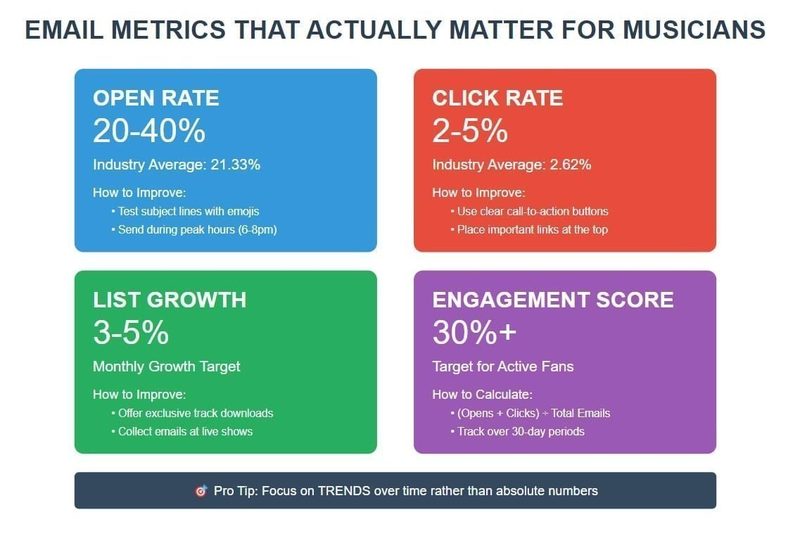
Email open rates for music newsletters average 20-30%, compared to social media organic reach rates of 2-10%. When you send an email announcing a new release, 20-30% of your subscribers see it within the first hour. On Instagram, the same announcement might reach 5% of your followers over several days. Email delivers immediate, reliable reach.
Email subscribers are your most engaged fans. Someone who joins your email list has taken a deliberate action to hear from you directly. These fans are more likely to stream your music on release day, buy merchandise, attend shows, and support crowdfunding campaigns. Building an email list is not just about marketing, it is about identifying and nurturing your core fan base.
Creating Lead Magnets That Convert
A lead magnet is an incentive you offer in exchange for an email address. It converts passive website visitors or social media followers into active email subscribers. The best lead magnets for musicians provide immediate value related to your music.
Free download: Offer one song as a free download when someone joins your list. The song should be one of your best tracks, not a throwaway. A download link creates immediate reciprocity: the fan got something valuable from you, and they are more likely to engage with future emails. DistroKid, TuneCore, and CD Baby all support free download codes.
Exclusive content: Offer something that fans cannot get anywhere else. Options include a live recording, an acoustic version of a released song, a demo or early version of a track, tablature or chord charts, sample packs, or preset packs for music producers. Exclusive content rewards subscribers with insider access.
Resource guide: If your music brand includes educational content, offer a resource guide as a lead magnet. Examples: a gear buying guide, a home studio setup checklist, a practice routine template, or a list of essential music production plugins. Educational lead magnets attract high-quality subscribers who are genuinely interested in your expertise.
Discount code: If you sell merchandise, offer a 10-15% discount code for joining your list. Merch discounts convert casual listeners into buyers and generate immediate revenue. This works best when paired with a new merchandise drop.
Contest or giveaway: Partner with another musician or brand to offer a prize package. Entry requires joining the email list. Giveaways can rapidly grow your list but often attract less engaged subscribers. Use giveaways sparingly and target them to your specific genre community.
Choosing an Email Service Provider
An email service provider (ESP) manages your subscriber list, sends emails, and provides analytics. Consumer email accounts like Gmail or Outlook are not designed for bulk sending and will flag your messages as spam. You need a dedicated ESP.
Mailchimp: The most popular ESP for beginners. Offers a free tier for up to 500 subscribers and 1,000 sends per month. Mailchimp provides customizable signup forms, landing pages, basic automation, and detailed analytics. The interface is user-friendly but the free tier limits automation features. Best for artists just starting with email marketing.
ConvertKit: Designed specifically for creators and artists. ConvertKit excels at subscriber tagging and segmentation, allowing you to send targeted emails based on subscriber behavior. The automation features are more powerful than Mailchimp. ConvertKit does not offer a free tier, but the paid plan starts at a reasonable monthly rate. Best for artists who want advanced segmentation and automation.
Bandzoogle: An all-in-one website builder and email marketing platform designed for musicians. Bandzoogle includes built-in mailing list tools, signup forms integrated with your website, and fan management features. If you use Bandzoogle for your website, the email tools integrate seamlessly. Best for artists who want a complete website and email solution in one platform.
Buttondown: A minimalist newsletter platform popular with independent creators. Buttondown focuses on simplicity: you write in Markdown, it handles subscriptions and analytics, and the emails look clean and text-focused. The pricing is transparent and affordable. Best for artists who prefer a simple, text-first newsletter without complex templates.
Newsletter Content Strategy
Once people join your list, you need to send emails they actually want to open. A good music newsletter balances promotional content with value-driven content that builds the artist-fan relationship.
New release announcements: These are your most important emails. When you drop a new single, album, or video, email your list first. Give subscribers early access or exclusive content as a reward for being on the list. Include a clear call to action: stream the song, pre-save the album, or watch the video.
Behind-the-scenes content: Share the stories behind your songs, studio photos, recording anecdotes, or tour diary entries. This content humanizes you and builds a deeper connection. Fans who feel personally connected to an artist are more likely to support them financially.
Personal updates: Share what is happening in your life as a musician. New gear you are excited about, a book you are reading, a collaboration you are working on, or a challenge you are facing. Authentic personal updates make your newsletter feel like a letter from a friend rather than a marketing broadcast.
Exclusive offers: Give your email list first access to merchandise drops, limited-edition vinyl pre-orders, ticket presale codes, and discounted bundles. Exclusive offers make subscribers feel valued and incentivize them to stay on the list.
Curated recommendations: Share what you are listening to. Curated playlists or recommendations from you position you as a tastemaker and provide value beyond your own music. This type of content is highly shareable and can attract new subscribers.
Frequency: Send emails 1-4 times per month. Once per week is ideal for active periods around a release. Once every two weeks is sustainable for between-release periods. Never send more than once per week unless you have a specific campaign. Always include a clear unsubscribe link in every email.
Practice Plan
| Week | Focus Area | Exercise | Duration |
|---|---|---|---|
| 1 | ESP Setup | Create an account with Mailchimp, ConvertKit, or Buttondown. Set up your subscriber list, create a signup form, and add it to your website and social media bios. | 45 min |
| 2 | Lead Magnet Creation | Create a lead magnet: a free download of one song, a live recording, or a resource guide. Write a compelling description. Test the signup flow yourself. | 60 min |
| 3 | Welcome Email Sequence | Write a 3-email welcome sequence: Email 1: thank you and deliver the lead magnet. Email 2: share your story and best content. Email 3: share your music and ask for a stream or follow. | 45 min |
| 4 | Newsletter Content Batch | Write 4 newsletter drafts for the next month. Include one release announcement, one BTS story, one personal update, and one curated recommendation list. | 60 min |
| 5 | List Building Campaign | Run a 1-week campaign to grow your list: promote your lead magnet on all social platforms, add a pop-up form to your website, and mention the list at your next live show. | 30 min/day |
| 6 | Analytics Review | Review your first month of email analytics. Check open rate, click rate, unsubscribe rate, and list growth. Compare with industry benchmarks (20% open, 3% click). Adjust your subject lines and content based on what performs best. | 30 min |
Frequently Asked Questions
How many email subscribers do I need as a musician?
Quality matters more than quantity. A list of 200 engaged subscribers who open your emails and stream your music on release day is more valuable than 2,000 subscribers who never open. Focus on growing a list of fans who genuinely want to hear from you. Start with 100 subscribers and build from there. Even 50 dedicated email fans can create meaningful release-day momentum.