Table of Contents
Introduction
Strumming is the engine of rhythm guitar. You can know every chord in the book, but if your strumming hand does not drive the beat consistently, the music falls flat. Many beginners focus entirely on their fretting hand and neglect the picking hand, which determines dynamics, groove, and energy. This guide covers five essential strumming patterns that appear in rock, pop, folk, reggae, and funk. Each pattern builds on the previous one, so work through them in order.
Key Takeaways
- Use your wrist, not your arm. The strumming motion comes from rotating your forearm with a loose wrist, not from swinging your whole shoulder.
- Downstrokes and upstrokes have different sounds. Downstrokes are fuller; upstrokes are lighter. Good strumming balances both.
- A metronome is non-negotiable. Practice every pattern at 60 BPM before increasing speed.
- Muting unwanted strings with your palm or fretting hand separates clean strumming from messy noise.
- Five patterns cover 80% of popular music: down-up, rock, folk, reggae chop, and syncopated funk.
Strumming Fundamentals: Grip and Motion
Your picking hand should hold the pick between your thumb and the side of your curled index finger. Only the tip of the pick extends past your thumb. If too much pick shows, it catches on strings and produces a flapping sound. If too little shows, the pick slides off the strings without enough bite. The ideal exposure is about 3 to 4 millimeters.
The strumming motion comes from rotating your forearm at the elbow, with the wrist staying slightly loose. Think of turning a doorknob back and forth, not hammering a nail. Your hand should travel across the strings at a slight downward angle, about 15 degrees, so the pick glides rather than catches. When you strum down, you hit the low strings first and sweep toward the high strings. When you strum up, you reverse the path. Keep the motion economical. A big windup of the entire arm creates lag and makes fast patterns feel impossible.
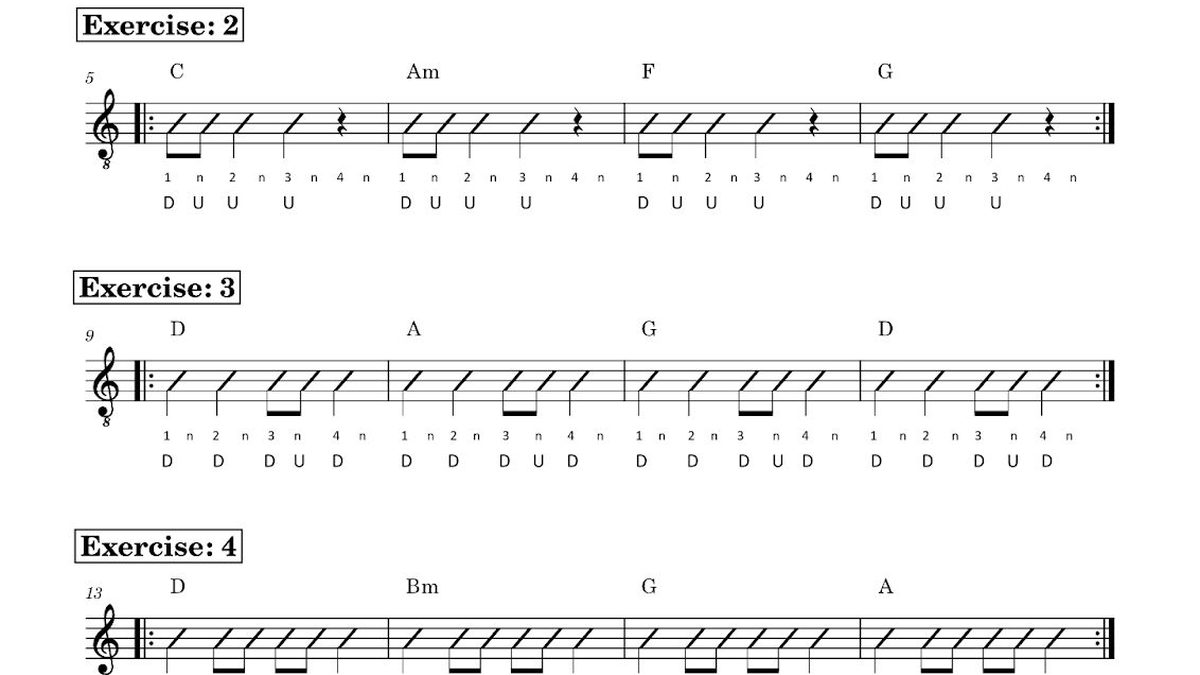
Pattern 1: The Basic Down-Up (8th Notes)
This is the foundation of all strumming. Play a downstroke on every beat and an upstroke on every offbeat. Set your metronome to 60 BPM and strum down on each click, up between clicks. Strum a G chord and focus on hitting all six strings evenly. The upstroke should be quieter and lighter than the downstroke; this natural accent gives the rhythm shape.
Most beginners rush the upstroke because they tense up. Stay relaxed and let the pick bounce off the strings naturally. If you feel your forearm burning, loosen your grip on the pick. Practice this pattern on G, then C, then D, then switch between them every four bars. Aim for steady eighth notes with no gaps. A common drill is to strum down-up repeatedly on a single chord for 60 seconds without stopping. Do this daily for a week before moving to pattern 2.
Pattern 2: The Rock Pattern
The rock pattern skips the second downstroke in each measure, creating a driving pulse. Count "1, 2-and, 3, 4-and." Strum down on beat 1, down on beat 2, up on "and" after 2, down on beat 3, down on beat 4, up on "and" after 4. This pattern powers thousands of rock songs from "Brown Eyed Girl" to "Last Dance with Mary Jane."
When you skip the upstroke after beat 1, your hand still moves up through the air even though it does not hit the strings. This "ghost strum" keeps your arm in motion and maintains the rhythm. If you stop your hand between strums, the pattern will feel jerky. Practice the rock pattern with an Em chord first, then switch to A and D. Once comfortable, try it with a G-C-D progression at 80 BPM.
Pattern 3: The Folk Pattern
Folk strumming uses a fingerpicking-like feel with a "boom-chick" bass pattern. For this pattern, you emphasize the bass notes on beats 1 and 3 by strumming only the bottom three strings on the downstroke, then strumming all strings on the upstroke. The pattern sounds like: down (bass), up, down (bass), up, down (full), up, down (full), up.
This pattern works beautifully with open chords like G, C, and D. The key is separating the bass strum from the full strum. On the bass strum, aim your pick toward the low E, A, and D strings. On the full strum, sweep across all six. Practice this slowly. Folk music relies on steady, predictable rhythm, so consistency matters more than speed. Try playing the G-C-D progression with this pattern at 70 BPM.
Pattern 4: The Reggae Chop
Reggae strumming flips the emphasis entirely. Instead of hitting the downbeats hard, you play quick, muted strums on the offbeats (the "and" counts). The on-beats are silent, creating a bouncy, syncopated rhythm. To mute the strings, release pressure from your fretting hand slightly so the strings buzz against the frets, then strum a short, percussive chop on the upstroke.
Count "1-and-2-and-3-and-4-and" but only strum on the "and" counts. Each strum is a quick, sharp upstroke with immediate muting. Practice this on an Am chord. The tricky part is keeping your hand moving in steady eighth notes while only making contact on the offbeats. Use a metronome set to 70 BPM and count aloud. Once the offbeat chop feels natural, try alternating between downstroke chords and offbeat chops for a more dynamic reggae rhythm.
Pattern 5: Syncopated Funk
Funk strumming uses a 16th-note feel with accented upstrokes. The basic pulse is "1-e-and-a-2-e-and-a." You keep your hand moving in steady 16th notes (four strums per beat), but you only let the pick hit the strings on specific strums, usually the upstrokes. The result is a tight, rhythmic "chick" sound that drives funk and R&B.
Start by muting all strings with your fretting hand. Your left hand hovers over the strings without pressing down, so every strum produces a percussive scratch. Then play down-up-down-up in steady 16th notes at 80 BPM, but only let the pick contact the strings on the upstrokes. Once the muted pattern feels comfortable, add chord changes. Open the fretting hand on certain beats to let the chord ring, then return to mute. This push-pull between open and muted is the essence of funk rhythm guitar.
Practice Routine
| Week | Focus | Duration |
|---|---|---|
| 1 | Basic down-up (pattern 1) on G, C, D, Em. Metronome at 60 BPM. No speed increase. | 10 min/day |
| 2 | Add rock pattern (pattern 2). Alternate 2 bars of down-up, 2 bars of rock. | 15 min/day |
| 3 | Add folk pattern (pattern 3). Focus on bass vs. full strum separation. | 15 min/day |
| 4 | Add reggae chop (pattern 4). Practice offbeat strumming with muted chords. | 15 min/day |
| 5 | Add syncopated funk (pattern 5). Muted practice first, then add open chords. | 15 min/day |
| 6 | Mix all five patterns. Switch patterns every 4 bars over a G-C-D-Em progression. | 20 min/day |
Frequently Asked Questions
- How hard should I hold the pick?
- Just tight enough that the pick does not spin or drop. If you see white knuckles, you are gripping too hard. The pick should pivot slightly when it hits the strings, absorbing impact rather than transmitting it to your hand.
- Why do my upstrokes sound weak?
- Weak upstrokes are almost always a pick angle issue. Tilt the pick so it glides across the strings rather than digging in. Practice upstrokes alone on a single string to build control.
- Should I use a metronome for strumming practice?
- Yes, absolutely. A metronome trains your internal clock and reveals timing inconsistencies that you would not notice otherwise. Start at 60 BPM and only increase by 5 BPM when the pattern feels effortless.
- What is ghost strumming?
- Ghost strumming is moving your hand through the strumming motion without hitting the strings. It keeps your arm in rhythm during rests and syncopated patterns. Think of it as the strum equivalent of a drummer's stick in the air between hits.
- Can I strum without a pick?
- Yes. Finger strumming produces a warmer, softer tone popular in folk and indie music. Use the flesh of your index finger for downstrokes and your thumbnail for upstrokes. The patterns remain the same, only the tone changes.
Conclusion
Great strumming is not about speed; it is about control. Master the five patterns in this guide one week at a time, always starting with a metronome at 60 BPM. Each pattern unlocks a different genre and style. Once you internalize these rhythms, you can walk into any jam session and hold down the groove. Start with pattern 1 on a G chord right now, and build from there.
Pro Tip: Always practice new strumming patterns with a metronome set to 60 BPM before increasing speed. A steady internal clock separates tight rhythm guitar from sloppy playing.