Table of Contents
Introduction
A scale is a sequence of notes ordered by pitch that serves as the raw material for melodies and chords. The seven diatonic modes (Ionian, Dorian, Phrygian, Lydian, Mixolydian, Aeolian, Locrian) are variations of the major scale, each starting on a different degree and producing a unique tonal character. Understanding scales and modes allows you to improvise with confidence, compose with intentional emotional impact, and analyze why certain chord progressions work. This guide covers major and minor scales, each mode in detail, and how to apply them on your instrument.
Key Takeaways
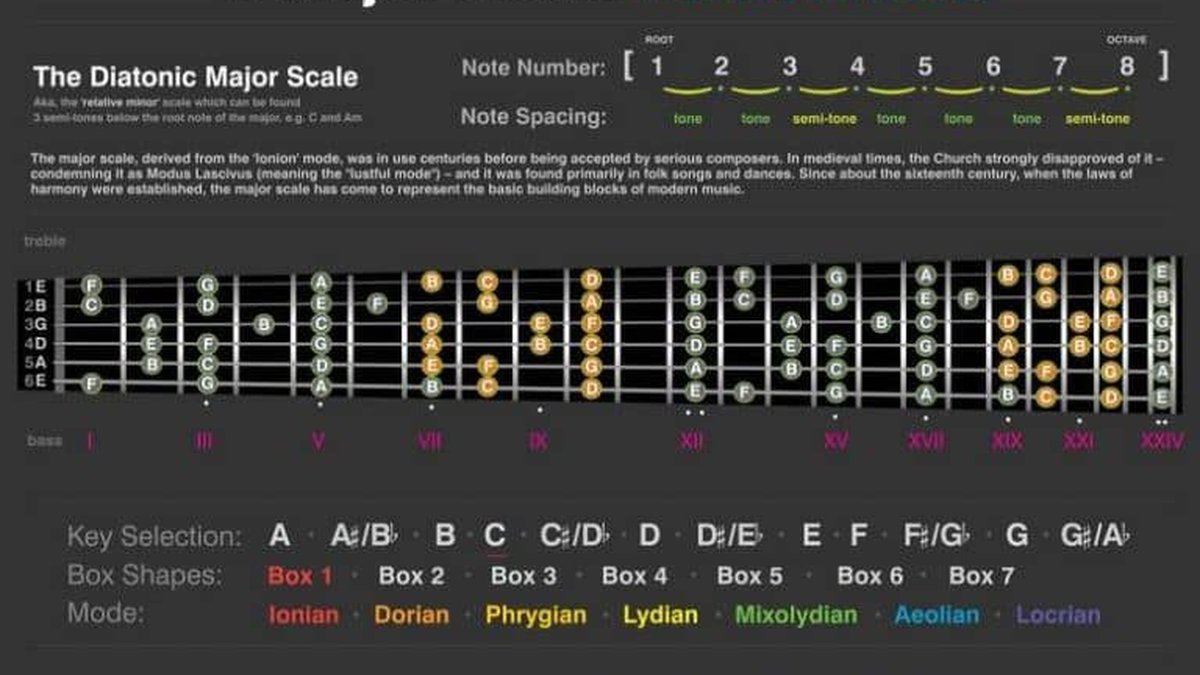
- Major scale formula: Whole-Whole-Half-Whole-Whole-Whole-Half (W-W-H-W-W-W-H). This pattern defines all major scales.
- Each mode has a unique character: Ionian (happy), Dorian (jazzy minor), Phrygian (Spanish/dark), Lydian (dreamy), Mixolydian (bluesy), Aeolian (sad), Locrian (unstable/diminished).
- Relative modes share the same key signature. C Ionian, D Dorian, E Phrygian, F Lydian, G Mixolydian, A Aeolian, B Locrian all use white keys only.
- Parallel modes start on the same root. C Ionian vs C Dorian: the 3rd and 7th are flattened in Dorian.
- Minor scales have three forms: natural (Aeolian mode), harmonic (raised 7th), and melodic (raised 6th and 7th ascending).
The Major Scale: The Parent Scale
The major scale is the most important scale in Western music. Its pattern of whole and half steps is W-W-H-W-W-W-H. On a piano, the C major scale uses only white keys: C-D-E-F-G-A-B-C. This is the only major scale without sharps or flats. To build a major scale starting on any note, apply the W-W-H-W-W-W-H pattern. For G major: G-A (whole), A-B (whole), B-C (half), C-D (whole), D-E (whole), E-F-sharp (whole), F-sharp-G (half). G major has one sharp: F-sharp. The major scale has seven degrees, numbered 1 through 7. Each degree has a name: tonic (1), supertonic (2), mediant (3), subdominant (4), dominant (5), submediant (6), and leading tone (7). These names describe the function of each note within the key. The tonic is the home note, the dominant creates the strongest pull back to the tonic, and the leading tone is a half step below the tonic, creating maximum resolution tension. Understanding scale degrees is essential for analyzing chord progressions and building melodies that resolve effectively.
Natural, Harmonic, and Melodic Minor
The natural minor scale (Aeolian mode) follows the pattern W-H-W-W-H-W-W. A natural minor: A-B (whole), B-C (half), C-D (whole), D-E (whole), E-F (half), F-G (whole), G-A (whole). Natural minor sounds sad and is the relative minor of the major scale. C major and A minor share the same key signature (no sharps, no flats) because A is the sixth degree of C major. Every major key has a relative minor, found a minor third below the tonic. The harmonic minor scale raises the 7th degree by a half step, creating a leading tone that strongly resolves to the tonic. A harmonic minor: A-B-C-D-E-F-G-sharp-A. The 3-semitone gap between the 6th and 7th degrees (F to G-sharp) gives harmonic minor its distinctive Middle Eastern or classical sound. The melodic minor scale raises both the 6th and 7th degrees ascending but reverts to natural minor descending. A melodic minor ascending: A-B-C-D-E-F-sharp-G-sharp-A. Descending: A-G-F-E-D-C-B-A (natural minor). Melodic minor smooths out the awkward 3-semitone gap of harmonic minor, making it more suitable for melodic lines. Jazz musicians often use the melodic minor scale ascending and descending with the raised 6th and 7th.
The Seven Modes Explained
Each mode is a rotation of the major scale. If you play a C major scale but start and end on D, you are playing D Dorian. The seven modes and their characteristic intervals: Ionian (major scale, no alterations) sounds bright and stable. Dorian (natural minor with raised 6th) sounds like a jazzy minor: the raised 6th makes it less dark than Aeolian. Phrygian (natural minor with lowered 2nd) has a dark, Spanish, or Middle Eastern flavor from the half-step between the 1st and 2nd degrees. Lydian (major scale with raised 4th) sounds dreamy and floating: the raised 4th creates a half-step between 4 and 5, giving it an ethereal quality. Mixolydian (major scale with lowered 7th) sounds bluesy and dominant: the flat 7th is the defining interval of dominant seventh chords, making Mixolydian the go-to mode for blues and rock improvisation. Aeolian (natural minor, no alterations) sounds sad and is the standard minor key. Locrian (natural minor with lowered 2nd and lowered 5th) sounds unstable and diminished: the flat 5th (tritone from the root) makes Locrian the most dissonant mode, rarely used as a tonal center but important for improvising over diminished and half-diminished chords.
Parallel Modes Comparison
Parallel modes start on the same root note, making their differences easy to hear. C Ionian: C-D-E-F-G-A-B-C. C Dorian: C-D-Eb-F-G-A-Bb-C (flat 3, flat 7). C Phrygian: C-Db-Eb-F-G-Ab-Bb-C (flat 2, flat 3, flat 6, flat 7). C Lydian: C-D-E-F#-G-A-B-C (sharp 4). C Mixolydian: C-D-E-F-G-A-Bb-C (flat 7). C Aeolian: C-D-Eb-F-G-Ab-Bb-C (flat 3, flat 6, flat 7). C Locrian: C-Db-Eb-F-Gb-Ab-Bb-C (flat 2, flat 3, flat 5, flat 6, flat 7). Learn parallel modes by memorizing which degrees are altered from the major scale. Dorian lowers 3 and 7. Phrygian lowers 2, 3, 6, 7. Lydian raises 4. Mixolydian lowers 7. Aeolian lowers 3, 6, 7. Locrian lowers 2, 3, 5, 6, 7. This system helps you construct any mode from any root without memorizing key signatures.
Modal Harmony and Chord Progressions
Each mode has a characteristic chord progression that defines its sound. Ionian uses the I-IV-V-I progression (C-F-G-C) as its defining resolution. Dorian often uses i-IV (Dm-G) or i-ii (Dm-Em), avoiding the V chord because the V in Dorian is minor, not major. Phrygian uses i-bII (Em-F) creating the characteristic Phrygian half-step resolution. Lydian uses I-II (F-G) with the raised 4th creating a major chord on the II degree. Mixolydian uses I-bVII (G-F) returning to the tonic, common in rock and blues. Aeolian uses i-bVI-bVII (Am-F-G) or i-iv-v (Am-Dm-Em). Locrian is rarely used as a tonal center because the diminished triad on the tonic is unstable; it is used over half-diminished chords in jazz. When composing modal music, emphasize the characteristic note of the mode (the note that distinguishes it from major or natural minor) by playing it prominently in the melody or placing it in the bass. For Dorian, emphasize the raised 6th. For Lydian, emphasize the raised 4th. For Mixolydian, emphasize the flat 7th.
Practice Exercises
| Exercise | Task | Goal |
|---|---|---|
| 1 | Play C major scale ascending and descending, saying each note name | Memorize major scale pattern |
| 2 | Build major scales starting on G, D, A, F, Bb | Apply W-W-H-W-W-W-H pattern |
| 3 | Play all seven modes of C major starting on each white key | Hear each mode's character |
| 4 | Improvise a melody in D Dorian using only white keys | Apply relative mode concept |
| 5 | Compare C Ionian vs C Dorian vs C Phrygian on your instrument | Learn parallel mode differences |
Frequently Asked Questions
- Do I need to memorize all seven modes?
- Focus on Ionian, Dorian, Mixolydian, and Aeolian first. These four cover most popular music genres. Lydian and Phrygian are useful for jazz and world music. Locrian is specialized for specific jazz chord types.
- What is the difference between relative and parallel modes?
- Relative modes share the same key signature (C Ionian and D Dorian both have no sharps or flats). Parallel modes share the same root but different key signatures (C Ionian vs C Dorian). Learn relative modes for playing over chord changes, learn parallel modes for understanding tonal differences.
- How do I know which mode to use over a chord?
- Match the mode to the chord quality. Over a major chord, use Ionian, Lydian, or Mixolydian. Over a minor chord, use Dorian, Phrygian, or Aeolian. Over a diminished chord, use Locrian. The chord's extensions (7th, 9th, 11th, 13th) tell you which mode fits.
- Why do some modes sound happy and others sad?
- The quality of the 3rd determines major vs minor feel. Modes with a major 3rd (Ionian, Lydian, Mixolydian) sound happy. Modes with a minor 3rd (Dorian, Phrygian, Aeolian, Locrian) sound sad or dark. The 2nd, 6th, and 7th degrees add additional color.
- Can I use modes in electronic music production?
- Yes. Modes are used extensively in electronic genres. Dorian is common in deep house and techno for its moody but not depressing character. Phrygian appears in melodic techno and psytrance for its exotic tension. Lydian is popular in cinematic and ambient production for its dreamy quality.
Conclusion
Scales and modes are the raw material of melody and harmony. Learn the major scale pattern first, then explore the seven modes by starting the major scale on each degree. Focus on the four most common modes (Ionian, Dorian, Mixolydian, Aeolian) before progressing to Lydian, Phrygian, and Locrian. Practice both relative modes (same key, different root) and parallel modes (same root, different intervals) to internalize their unique sounds.
Key Stat: Modes with a major 3rd (Ionian, Lydian, Mixolydian) sound happy. Modes with a minor 3rd (Dorian, Phrygian, Aeolian, Locrian) sound sad or dark. The 2nd, 6th, and 7th add additional color.