Table of Contents
- Introduction
- Table of Contents
- Triads: Major, Minor, Diminished, Augmented
- Seventh Chords: Major 7, Dominant 7, Minor 7, Half-Diminished, Diminished 7
- Inversions: Root Position, First, Second, Third
- Diatonic Chords: Chord Scale Theory
- Extended Chords: 9ths, 11ths, 13ths
- Practice Exercises
- Frequently Asked Questions
- Conclusion
Introduction
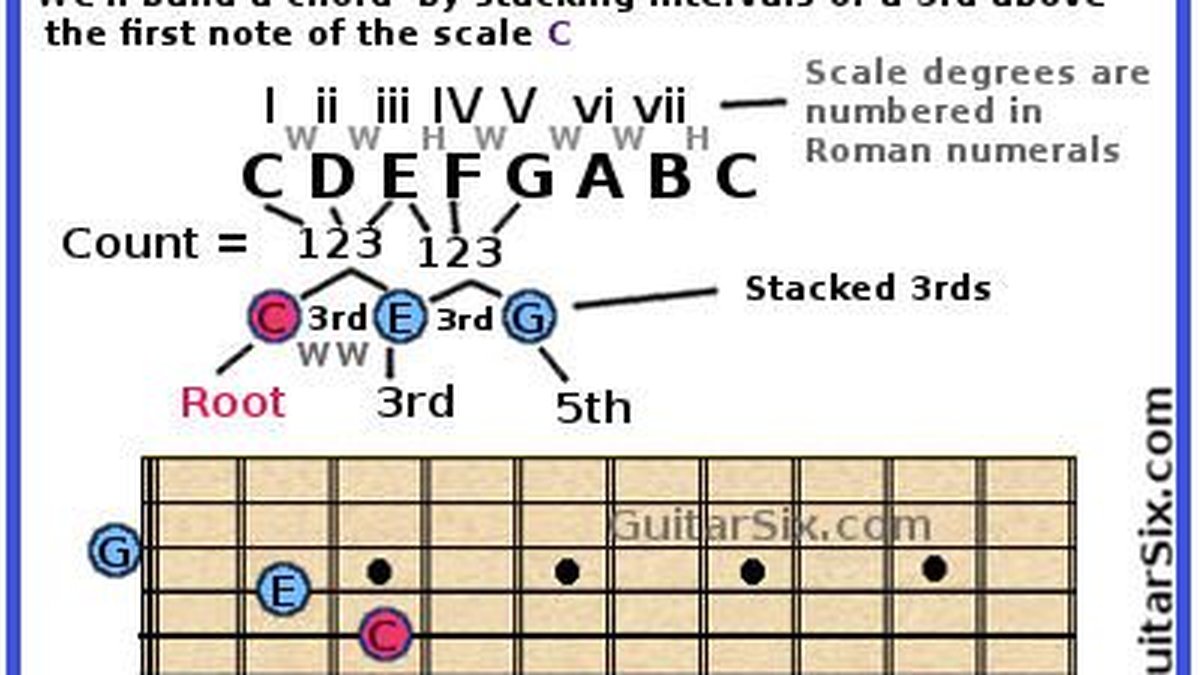
A chord is three or more notes played simultaneously. Chords are built by stacking intervals, most commonly thirds, on top of a root note. The simplest chords are triads (three notes), and the next level is seventh chords (four notes). Understanding chord construction lets you analyze any chord symbol, create your own voicings, and compose progressions with intentional emotional impact. This guide covers all triad types, seventh chords, inversions, and extended harmony.
Key Takeaways
- Triads stack two thirds on a root. The quality of each third determines the chord type: major (M3 + m3), minor (m3 + M3), diminished (m3 + m3), augmented (M3 + M3).
- Seventh chords add one more third on top of a triad. The seventh quality (major, minor, diminished) combines with the triad quality to create five common seventh chord types.
- Inversions rearrange the order of notes. Root position has the root in the bass; first inversion has the third in the bass; second inversion has the fifth in the bass.
- Diatonic chords are built from the notes of a scale. In C major, the diatonic triads are C, Dm, Em, F, G, Am, Bdim.
- Extended chords (9th, 11th, 13th) add notes beyond the octave, creating richer harmonic colors used in jazz and modern pop.
Triads: Major, Minor, Diminished, Augmented
A triad consists of a root, a third, and a fifth. The quality of the third (major or minor) combined with the quality of the fifth (perfect, diminished, or augmented) determines the chord type. Major triad: root + major 3rd (4 semitones) + perfect 5th (7 semitones). Example: C-E-G. Sounds bright and stable. Minor triad: root + minor 3rd (3 semitones) + perfect 5th (7 semitones). Example: C-Eb-G. Sounds sad or melancholic. Diminished triad: root + minor 3rd (3 semitones) + diminished 5th (6 semitones). Example: C-Eb-Gb. Sounds tense and unstable, often used as a passing chord. Augmented triad: root + major 3rd (4 semitones) + augmented 5th (8 semitones). Example: C-E-G#. Sounds dissonant and unresolved, creates a floating feeling. To build a triad starting from any note, first determine the chord quality you want, count the appropriate half steps for the third, then for the fifth. On guitar, triads appear as three-note voicings across strings 1-2-3, 2-3-4, or 3-4-5. On piano, triads are played with fingers 1-3-5 in root position. Practice playing all four triad types starting on every white key until you can recite the notes without looking.
Seventh Chords: Major 7, Dominant 7, Minor 7, Half-Diminished, Diminished 7
A seventh chord adds a fourth note a third above the fifth of a triad, creating a four-note chord. The five most common seventh chords are: Major 7 (maj7): major triad + major 7th (11 semitones). Cmaj7 = C-E-G-B. Sounds warm and lush. Dominant 7 (dom7): major triad + minor 7th (10 semitones). C7 = C-E-G-Bb. Sounds bluesy and creates strong tension that resolves to the IV chord (in C major, C7 resolves to F). Dominant 7 is the most important seventh chord in Western harmony. Minor 7 (m7): minor triad + minor 7th (10 semitones). Cm7 = C-Eb-G-Bb. Sounds cool and jazzy, the default minor seventh chord. Half-diminished 7 (m7b5): diminished triad + minor 7th (10 semitones). Cm7b5 = C-Eb-Gb-Bb. Sounds dark and tense, appears on the seventh degree of major scales. Diminished 7 (dim7): diminished triad + diminished 7th (9 semitones, which is enharmonically a major 6th). Cdim7 = C-Eb-Gb-A. Sounds extremely tense and symmetrical (all notes are a minor third apart), used as a passing chord in classical and jazz. The diminished 7 chord is unique because it repeats every minor third: Cdim7, Ebdim7, Gbdim7, and Adim7 contain the same four notes.
Inversions: Root Position, First, Second, Third
An inversion changes which note of the chord is in the bass. Root position has the root in the bass (C-E-G). First inversion has the third in the bass (E-G-C). Second inversion has the fifth in the bass (G-C-E). For seventh chords, third inversion has the seventh in the bass (B-C-E-G for Cmaj7). Inversions change the character of a chord without changing its harmonic function. First inversion softens the chord and makes it less final. Second inversion creates instability and often resolves to root position or first inversion. Inversions are essential for smooth voice leading: when moving from one chord to the next, keep common tones in the same voice and move other voices by the smallest possible interval. On guitar, inversions are played as different chord shapes on the fretboard. A C major chord in root position uses an open C shape; first inversion uses a C/E shape (often played with the 5th string muted). On piano, inversions are fingered 1-2-5 (first inversion) or 1-3-5 (second inversion) for triads. Practice playing each triad type in all three inversions up and down the keyboard or fretboard.
Diatonic Chords: Chord Scale Theory
Diatonic chords are the chords that naturally occur within a scale by stacking thirds on each scale degree. In C major, the diatonic triads are: C major (I), D minor (ii), E minor (iii), F major (IV), G major (V), A minor (vi), B diminished (vii). The pattern of chord qualities (major, minor, minor, major, major, minor, diminished) is the same for every major key. In A natural minor, the diatonic triads are: A minor (i), B diminished (ii), C major (III), D minor (iv), E minor (v), F major (VI), G major (VII). The chord-scale relationship explains why certain chord progressions sound natural: the I-IV-V-I progression uses only diatonic chords. The ii-V-I progression (Dm-G-C in C major) is the most important progression in jazz, formed from the 2nd, 5th, and 1st degrees. Understanding diatonic chords lets you harmonize any melody by using chords that share the same key. When you encounter a non-diatonic chord (a chord with notes outside the key), it indicates a key change or modal borrowing. For example, a C major chord in the key of A minor is borrowed from the parallel major (A major).
Extended Chords: 9ths, 11ths, 13ths
Extended chords add notes beyond the seventh, continuing to stack thirds. A ninth chord adds the 9th degree (the 2nd degree plus an octave). Cmaj9 = C-E-G-B-D. A dominant 9th (C9) = C-E-G-Bb-D. An eleventh chord adds the 11th (the 4th degree plus an octave). Cmaj11 = C-E-G-B-D-F. In practice, the 3rd is often omitted from 11th chords to avoid a clash between the 3rd and the 11th (the "avoid note"). A thirteenth chord adds the 13th (the 6th degree plus an octave). Cmaj13 = C-E-G-B-D-F-A. The 11th is often omitted from 13th chords because it clashes with the 3rd. Extended chords are fundamental in jazz harmony but appear in pop, R&B, and modern production as well. A Cmaj7(9) chord (C-E-G-B-D) adds a lush, sophisticated color to an otherwise simple major chord. In practice, extended chords are often voiced with the root in the bass by a bass player and the upper extensions played by a keyboard or guitar, allowing for more compact voicings that avoid muddy low-end clusters.
Practice Exercises
| Exercise | Task | Goal |
|---|---|---|
| 1 | Build major, minor, diminished, augmented triads on C, G, F | Memorize four triad types |
| 2 | Play all three inversions of C major and A minor triads | Practice inversion shapes |
| 3 | Build all five seventh chord types on C root | Learn seventh chord construction |
| 4 | Identify diatonic triads in C, G, and F major keys | Apply chord-scale theory |
| 5 | Voice a Cmaj9 chord on your instrument | Explore extended harmony |
Frequently Asked Questions
- Why are some chords called major and others minor?
- The quality of the third determines major vs minor. A major chord has a major third (4 semitones from the root). A minor chord has a minor third (3 semitones). The fifth is perfect in both. The third is the single most important interval for determining chord quality.
- What is a sus chord (suspended)?
- A suspended chord replaces the third with either a second (sus2) or a fourth (sus4). Csus2 = C-D-G. Csus4 = C-F-G. Sus chords sound open and unresolved because they lack the third that defines major or minor quality. They often resolve to the major or minor triad.
- How do I use seventh chords in pop music?
- Major 7 chords work on the I and IV degrees for a warm, sophisticated sound. Dominant 7 chords work on the V degree for tension. Minor 7 chords work on the ii, iii, and vi degrees. Adding a 7th to a chord costs nothing in terms of finger positioning and instantly adds harmonic interest.
- What is voice leading?
- Voice leading is the smooth movement of individual notes (voices) from one chord to the next. Good voice leading keeps common tones in the same voice, moves voices by the smallest possible intervals, and avoids parallel fifths and octaves. Inversions are essential for good voice leading.
- Do I need to know chord theory to write songs?
- No. Many hit songs use simple diatonic triads. But chord theory gives you tools to create intentional emotional effects, add harmonic interest without guesswork, and communicate with other musicians. Even basic triad knowledge significantly expands your songwriting pallette.
Conclusion
Chord construction is the practical application of interval knowledge. Start with the four triad types (major, minor, diminished, augmented), then add seventh chords for richer harmony. Practice inversions for smooth voice leading, learn diatonic chords to understand chord-scale relationships, and explore extended chords for advanced harmonic colors. Building a chord from any root becomes automatic with consistent practice.
Key Stat: Chords are built by stacking intervals on a root note. Start with four triad types (major, minor, diminished, augmented), then add seventh chords for richer harmony.