Table of Contents
The way we record music has changed more in the last seventy years than in the previous several thousand. For most of human history, music existed only in the moment it was performed. If you were not in the room, you did not hear it. The invention of recording changed that, but the early systems were primitive by modern standards. From wax cylinders to magnetic tape to digital audio workstations, each technological leap has fundamentally changed how music is created, consumed, and understood.
Understanding the evolution of recording technology is not just a history lesson. It explains why certain records sound the way they do, why some production techniques are still used today, and how the democratization of recording tools has reshaped the music industry. This guide traces the key milestones in recording history and their lasting impact on music production.
Key Takeaways
- Magnetic tape recording, developed in the 1940s-50s, created the warm saturation and compression that many producers still emulate today
- The invention of multitrack recording by Les Paul in the 1950s allowed musicians to layer performances and changed studio recording forever
- Digital recording in the 1980s introduced perfect fidelity, no tape hiss, and non-destructive editing capabilities
- The DAW revolution of the 1990s-2000s put professional recording tools in every home, democratizing music production
- The analog revival of the 2010s reflects a desire for the character, workflow, and sound of tape-based recording
The Analog Tape Era
The story of modern recording begins with magnetic tape. Before tape, recording was done directly to disc or wax cylinder, offering limited fidelity and no editing capability. Tape changed everything by allowing recordings to be edited by physically cutting and splicing the magnetic ribbon.
The birth of tape recording: Magnetic tape recording was developed in Germany during the 1930s and 1940s. After World War II, American engineers brought the technology back to the United States, where it rapidly transformed the recording industry. Ampex, a California company, produced the first commercially successful tape recorders. By the early 1950s, tape had become the standard recording medium in professional studios. Tape offered several advantages over direct-to-disc recording: longer recording times, the ability to erase and reuse tape, and the ability to edit recordings by cutting and splicing the physical tape.
Tape saturation and compression: Analog tape has a characteristic nonlinear response to loud signals. When the signal level exceeds a certain threshold, the tape saturates, gently compressing the audio and adding even-order harmonic distortion. This saturation is widely considered musically pleasing. It smooths out transients, adds warmth, and glues the mix together. The Beatles, Led Zeppelin, and countless other classic artists recorded on tape, and their records have a sonic character that many modern producers try to replicate with software emulations. The sound of tape is not objectively "better," but it is undeniably different from digital, and many listeners prefer its warmth.
Limitations of tape: Tape recording had significant practical limitations. Each take used physical tape, which was expensive. Editing required physically cutting the tape with a razor blade and rejoining it with splicing tape. Tape hiss was a constant background noise that had to be managed with noise reduction systems like Dolby. Over time, tape wears out. Repeated playback degrades the magnetic signal, and the oxide coating can shed, causing dropouts in the audio. A master tape recorded in 1960 might sound noticeably different today due to aging. Despite these limitations, the tape era produced some of the most celebrated recordings in history, and the techniques developed during this period continue to influence modern production.
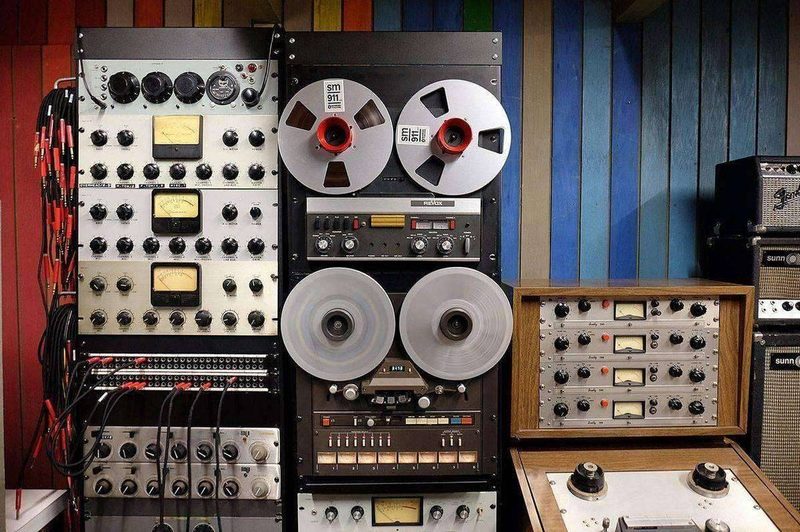
Classic tape machines: The most iconic tape machines include the Ampex AG-440, the Studer A80 and A800, and the Otari MTR-90. These machines were built to last, with precision mechanics and electronics that could operate reliably for decades. Many of these machines are still in use today, maintained by dedicated engineers who appreciate their sonic character. A well-maintained Studer A800 running two-inch tape at 30 inches per second is still considered the gold standard for analog recording by many engineers.
The Rise of Multitrack Recording
The invention of multitrack recording was perhaps the most transformative development in music production history. Before multitrack, everything had to be recorded live in a single take. If anyone made a mistake, everyone started over.
Les Paul and the first multitrack: Guitarist and inventor Les Paul is credited with developing the first multitrack recorder in the 1950s. He modified an Ampex tape recorder by adding a second recording head, allowing separate tracks to be recorded at different times and played back together. This ability to overdub performances opened possibilities that musicians had never imagined. Les Paul could record a guitar part, then record another part while listening to the first, and build up layers of sound one at a time. His recordings with his wife Mary Ford featured multiple vocal harmonies and guitar parts that would have been impossible to perform live.
From 4-track to 48-track: The first commercial multitrack machines offered 4 tracks. By the 1960s, 8-track machines became common, and the Beatles used a 4-track machine to create Sgt. Pepper's Lonely Hearts Club Band, one of the most sonically adventurous albums ever made. By the 1970s, 16-track and 24-track machines were standard in professional studios. The pinnacle of analog multitrack was the 48-track machine, which synchronized two 24-track machines with sophisticated timing control. Each additional track gave producers more flexibility to separate instruments, apply different effects, and make individual adjustments during mixing.
The impact on recording technique: Multitrack recording changed the role of the recording engineer and producer. No longer a passive documentarian, the producer became an active shaper of the sound, able to build recordings piece by piece. The "bounce" technique was essential: when all tracks were full, the engineer would mix several tracks down to one or two, freeing up space for more overdubs. This bouncing process required careful planning because it was irreversible. A mistake in the bounce could not be undone. The discipline enforced by multitrack tape creativity within constraints that many producers today find missing in unlimited-track digital recording.
The console as instrument: Multitrack recording elevated the mixing console to the level of a musical instrument. Large-format consoles like the Neve 8078, SSL 4000, and API Legacy became legendary for their sound. Each channel had its own preamp, EQ, and routing options. Engineers developed signature sounds based on how they used these consoles. The SSL 4000's bus compressor, for example, became famous for "gluing" the mix together and is still emulated in countless software plugins today.
The Digital Revolution
Digital recording arrived in the 1970s and became commercially viable in the 1980s. It represented a fundamental shift from storing audio as a continuous magnetic waveform to representing it as a series of numerical samples.
The Sony PCM and compact disc: Sony developed the PCM (pulse-code modulation) processor in the 1970s, allowing digital recording to be stored on video tape. The Sony PCM-1600 became the standard for digital mastering. In 1982, Sony and Philips introduced the compact disc, which brought digital audio to consumers. CDs offered 16-bit, 44.1 kHz audio with a dynamic range of 96 dB and no background hiss. The clarity and silence between notes were revolutionary compared to vinyl records and cassette tapes. The CD changed not only how people listened to music but also how it was mastered, because the medium had different sonic characteristics than vinyl.
Digital tape formats: The 1980s and 1990s saw a proliferation of digital tape formats for professional use. The Sony PCM-3348 was a 48-track digital multitrack recorder that offered consistent sound quality across all tracks with no generation loss. Digital Audio Tape (DAT) became popular for mastering and archiving because it offered CD-quality recording in a compact format. ADAT (Alesis Digital Audio Tape) recorded 8 tracks on a standard S-VHS tape, making digital multitrack affordable for project studios. ADAT machines could be synchronized to create 16, 24, or 32 track systems at a fraction of the cost of analog tape.
The advantages of digital: Digital recording eliminated tape hiss completely. The noise floor was determined by the bit depth (96 dB for 16-bit, 144 dB for 24-bit). Digital recordings did not degrade over time. A digital file copied perfectly retained every bit of information. Editing was non-destructive and precise: you could move, copy, and align audio with sample accuracy. No razor blades or splicing tape needed. Digital also enabled random access: you could instantly jump to any point in the recording without winding through tape. These advantages made digital recording faster, cleaner, and more flexible than analog.
Early digital criticism: Many engineers and listeners felt that early digital recordings sounded harsh, brittle, and "cold" compared to analog tape. The problem was not digital audio itself but the combination of limited bit depth, poor analog-to-digital converters, and unfamiliar mixing techniques. Early digital consoles and converters were primitive by modern standards. As conversion technology improved and engineers learned to work with digital tools, the sound quality gap narrowed significantly. Today, high-resolution digital recording (24-bit, 96 kHz or higher) can capture audio with fidelity that exceeds human hearing capabilities.
The DAW Era and Home Studios
The most recent revolution in recording technology is the digital audio workstation (DAW). Software like Pro Tools, Logic Pro, Ableton Live, Cubase, and FL Studio has replaced physical tape machines and consoles in most studios.
Pro Tools and the industry standard: Pro Tools, developed by Digidesign (later Avid), became the industry standard DAW in the 1990s and 2000s. It offered multitrack recording, non-destructive editing, plugin support, and integrated mixing. Pro Tools workstations were installed in virtually every professional recording studio. The ability to share Pro Tools sessions between studios meant that a project could be recorded in one city, mixed in another, and mastered in a third without compatibility issues. Pro Tools remains the dominant DAW in professional studios, although competitors like Logic Pro and Ableton Live have significant market share in specific genres.
Democratization of production: The DAW revolution dramatically reduced the cost of professional-quality recording. A laptop with Logic Pro and a $200 audio interface could produce recordings that rivaled those made in million-dollar studios. The cost of entry dropped from thousands of dollars per hour of studio time to a one-time software purchase. This democratization led to an explosion of independent music. Bedroom producers could create, mix, and release music without ever stepping into a professional studio. Genres like electronic dance music, lo-fi hip-hop, and indie pop flourished under this model because they were built by producers working in home studios.
Virtual instruments and plugins: DAWs support virtual instruments and audio plugins that emulate analog hardware. Software synthesizers, samplers, and effects processors can replicate the sound of vintage synthesizers, tape machines, compressors, and reverbs with remarkable accuracy. A producer working entirely in a DAW can access sounds that would have cost hundreds of thousands of dollars in hardware just 20 years ago. The plugin ecosystem has become a major industry, with companies like Waves, Universal Audio, and iZotope developing emulations of classic studio gear that are used on professional recordings worldwide.
The infinite undo problem: One criticism of DAW-based recording is that the unlimited flexibility can lead to decision paralysis. With analog tape, every decision was consequential. You committed to a take, a mix, and a sound because redoing it was expensive and time-consuming. DAWs offer infinite undo, unlimited tracks, and the ability to edit at the microscopic level. Some producers argue that this removes the creative pressure that produces great performances. The solution many professionals adopt is to impose artificial constraints: limit track count, commit to effects early, and force decisions rather than leaving everything "for the mix."
The Analog Revival
In the 2010s and 2020s, a significant analog revival has occurred alongside the dominance of digital recording. Many producers and engineers have returned to tape, analog consoles, and outboard gear, not because they cannot achieve good results with digital tools, but because analog offers a different creative workflow and sonic character.
Hybrid recording: Most professional studios today use a hybrid approach: digital multitrack recording combined with analog outboard gear. Tracks are recorded into a DAW, but the signal passes through analog preamps, compressors, and EQs before hitting the converters. The mix is summed on an analog console or through analog summing boxes, then printed back into the DAW for mastering. This hybrid workflow gives engineers the flexibility of digital editing with the warmth and character of analog processing.
Tape emulation: For producers who cannot afford or maintain a real tape machine, software emulations offer a convincing alternative. Plugins like Universal Audio's Studer A800, Waves' Kramer Master Tape, and Slate Digital's Virtual Tape Machines emulate the saturation, compression, and frequency response of classic tape machines. While purists argue that only real tape sounds like tape, the emulations have become good enough that many listeners cannot tell the difference in blind tests.
The vinyl revival: The analog revival is not limited to recording. Vinyl records have experienced a remarkable comeback, with sales reaching levels not seen since the 1980s. Many artists now release their music on vinyl alongside digital formats. The process of mastering for vinyl imposes constraints that can improve the sound: excessive bass must be controlled, stereo spread must be managed, and the overall level must be reasonable. Some producers argue that these constraints lead to better-sounding recordings, even on digital formats.
Why analog persists: Analog technology persists because it offers a different creative relationship with sound. Working with tape forces decisions, limits revisions, and encourages committed performances. The hands-on interaction with physical controls on a console or outboard unit can be more intuitive and musical than working with a mouse and screen. The subtle nonlinearities and imperfections of analog equipment add character that digital processing sometimes lacks. The analog revival is not about rejecting digital but about recognizing that both technologies have strengths and that the best recordings often combine elements of both.
Practice Plan
| Week | Focus Area | Exercise | Duration |
|---|---|---|---|
| 1 | Listening History | Listen to five landmark recordings from different eras: a 1950s mono recording, a 1960s multitrack album, a 1970s 24-track production, a 1980s digital recording, and a modern DAW production. Note the sonic differences. | 2 hours |
| 2 | Tape Saturation Study | Download a tape saturation plugin demo. Apply it to a digital recording at different levels. A/B compare with and without saturation. Train your ear to hear the compression and harmonic distortion. | 45 min |
| 3 | Multitrack Analysis | Take a simple recording and listen to individual tracks in isolation. Identify how many tracks were used. Practice imagining how the song was built track by track during the recording process. | 60 min |
| 4 | Digital vs Analog Listening | Compare a track that was recorded entirely digitally to one that used analog tape or analog outboard. Listen for differences in transient response, saturation, and stereo image. Write down what you hear. | 45 min |
| 5 | Hybrid Workflow Practice | If you have access to analog gear, practice routing a DAW track through an analog compressor and back into the DAW. Compare the processed and unprocessed versions. Note the sonic change. | 60 min |
| 6 | Constraint Recording | Record a song with artificial constraints: maximum 8 tracks, no plugins, no editing. Commit to every decision. Compare the result to a song recorded with unlimited tracks and full editing freedom. | 2+ hours |
Frequently Asked Questions
Is analog tape really better than digital recording?
Neither is inherently better. Analog tape adds saturation, compression, and harmonic distortion that many listeners find pleasing. Digital offers perfect fidelity, no noise, and unlimited editing. The choice depends on the desired sound and workflow. Many modern recordings combine both: recording digitally but processing through analog gear for character.