Table of Contents
Stage fright is one of the most common challenges that musicians face. It affects beginners and professionals alike, from local open mic performers to Grammy-winning headliners. The physical symptoms are familiar: racing heart, sweaty palms, shallow breathing, trembling hands, and a feeling of unreality. These sensations are the body's natural response to perceived threat, the same "fight or flight" response that protected our ancestors from danger.
The good news is that stage fright is manageable. The musicians who appear calm and confident on stage are not people who never feel nervous. They are people who have developed techniques to channel that nervous energy into focused performance. This guide covers practical, evidence-based strategies for understanding, managing, and ultimately using performance anxiety to your advantage.
Key Takeaways
- Stage fright is a normal physiological response, not a personal failing; accepting it reduces its power over you
- Reframe nervousness as excitement: the physical sensations are identical, and interpreting them as positive energy improves performance
- Deep diaphragmatic breathing activates the parasympathetic nervous system and physically reduces anxiety symptoms within minutes
- Consistent pre-show routines create a sense of control and familiarity that counteracts the uncertainty of live performance
- Exposure therapy through repeated low-stakes performances is the most effective long-term treatment for stage fright
Understanding Performance Anxiety
Performance anxiety is not a sign of weakness or lack of talent. It is a biological response rooted in the amygdala, the part of the brain that detects threats and triggers the stress response. When you step on stage, your brain interprets the unfamiliar situation as potentially dangerous and activates the sympathetic nervous system. Adrenaline and cortisol flood your system, preparing you to fight or flee. But on stage, you can do neither. The energy has nowhere to go, and it manifests as shaking, sweating, and mental fog.
The Yerkes-Dodson law: This psychological principle describes the relationship between arousal and performance. Low arousal leads to boredom and poor performance. Moderate arousal leads to optimal performance. High arousal leads to anxiety and breakdown. The goal is not to eliminate nervousness but to find the arousal level where you perform best. For most musicians, this means accepting some nervousness as part of the process and learning to stay in the optimal zone. Too little adrenaline and you lack energy. Too much and you lose control. The sweet spot is different for everyone.
How stage fright manifests differently: Some musicians experience physical symptoms like trembling hands or a shaky voice. Others experience cognitive symptoms like blanking on lyrics or forgetting chord changes. Some feel the anxiety hours before the show, while others feel fine until the moment they step on stage. Identify your personal pattern. Knowing when and how your anxiety manifests helps you choose the right coping strategies. If your hands shake, focus on grounding techniques. If you forget lyrics, build deeper memorization into your preparation.
Stage fright and experience level: Experience does not eliminate stage fright, but it changes how you relate to it. Beginner musicians often fear technical failure: forgetting the music, playing wrong notes, or equipment malfunction. Professional musicians more often fear not connecting with the audience or not living up to their own standards. Both types of fear are valid, but they require different approaches. Beginners benefit most from preparation and practice. Professionals benefit most from mindset work and reframing expectations.
Mental Preparation and Mindset
The way you think about performance directly affects how you feel. Changing your mental framework is one of the most powerful tools for managing stage fright. These techniques come from sports psychology, cognitive behavioral therapy, and the experience of professional performers.
Reframing nervousness as excitement: The physical sensations of nervousness and excitement are nearly identical: elevated heart rate, rapid breathing, heightened alertness. The difference is entirely in how you interpret them. Research from Harvard Business School has shown that people who say "I am excited" instead of "I am nervous" perform significantly better in high-pressure situations. Before you go on stage, tell yourself: "I am excited to play. My heart is racing because my body is preparing to do something important." This simple reframe changes the emotional experience from negative to positive.
Visualization: Athletes have used visualization for decades to improve performance under pressure. The technique involves vividly imagining yourself performing successfully. Sit quietly before the show and close your eyes. Imagine walking onto the stage, hearing the crowd, feeling the instrument in your hands, seeing your bandmates, and playing the first notes perfectly. Imagine the sound, the feeling, and the audience's positive reaction. The more sensory detail you include, the more effective the visualization. Your brain does not fully distinguish between vividly imagined experiences and real ones, so visualization builds neural pathways that support confident performance.
Acceptance and commitment: Fighting against anxiety often makes it worse. Instead, practice acceptance. Acknowledge the feeling: "I notice that I am feeling nervous right now." Then commit to performing despite the feeling. You do not need to feel calm to perform well. You only need to play your instrument. The anxiety can be present without controlling your actions. This approach, drawn from acceptance and commitment therapy, reduces the secondary anxiety about being anxious that often compounds the original fear.
Process goals vs. outcome goals: Outcome goals focus on results: "I need to impress the audience" or "I must not make any mistakes." These goals create pressure because you cannot fully control outcomes. Process goals focus on actions you can control: "I will take three deep breaths before the first song" or "I will maintain eye contact with my bandmates during the bridge." Process goals reduce anxiety by shifting attention from uncontrollable outcomes to controllable actions. Before a show, set three process goals and focus on achieving them regardless of what else happens.
Physical Techniques for Calming Nerves
Mental techniques work best when combined with physical strategies that directly address the body's stress response. Since stage fright is a physical reaction, physical interventions can be highly effective.
Diaphragmatic breathing: Shallow chest breathing activates the sympathetic nervous system and maintains the stress response. Deep diaphragmatic breathing activates the parasympathetic nervous system, which calms the body. The technique is simple: inhale through your nose for four counts, feeling your belly expand. Hold for four counts. Exhale through your mouth for six counts, feeling your belly contract. The longer exhale is the key because it activates the vagus nerve, which signals the body to relax. Do ten cycles before going on stage. Repeat between songs if needed.
Progressive muscle relaxation: Anxiety causes muscle tension, which in turn signals the brain that danger is present. Progressive muscle relaxation breaks this cycle. Systematically tense and then relax each muscle group in your body. Start with your feet: tense the muscles for five seconds, then release for ten seconds. Move up through calves, thighs, abdomen, chest, hands, arms, shoulders, neck, and face. The contrast between tension and relaxation helps you recognize and release physical stress. This takes about five minutes and can be done in the green room or before load-in.
Grounding techniques: When anxiety spikes, grounding techniques anchor you in the present moment. The 5-4-3-2-1 technique is widely used: identify five things you can see, four things you can touch, three things you can hear, two things you can smell, and one thing you can taste. This exercise forces your brain to shift from abstract fear to concrete sensory input. It takes less than a minute and can be done while standing on stage before the first song.
Physical warm-up: Just as you warm up your instrument, warm up your body. Gentle stretching releases muscle tension that has accumulated from pre-show anxiety. Shoulder rolls, neck stretches, and arm shakes are simple and effective. A brief physical warm-up also signals to your brain that it is time to perform, creating a transition from waiting mode to performance mode. Include hand and finger stretches to reduce the trembling that affects many musicians.
Preparation and Routine Building
Consistent preparation reduces uncertainty, and uncertainty is one of the primary drivers of performance anxiety. When you know you have prepared thoroughly, your brain has less reason to trigger the fear response.
The pre-show routine: Develop a fixed sequence of actions that you perform before every show. This routine becomes a ritual that signals safety and predictability to your brain. A good pre-show routine includes physical warm-up, instrument check, mental preparation (visualization or breathing), and a final gear check. Perform the same routine in the same order regardless of venue size or audience type. The consistency of the routine itself is calming, regardless of what you actually do in each step.
Over-preparation: The best antidote to performance anxiety is knowing your material so thoroughly that you could perform it in your sleep. Over-prepare until the music is automatic. Practice until you can play the set while holding a conversation, while distracted, while tired. When your fingers know what to do without conscious thought, your conscious mind is free to handle the anxiety without affecting the music. Over-preparation also builds confidence. The more you practice, the more evidence you have that you can perform well.
Simulated performance: Practice performing under pressure by creating simulated performance conditions. Record yourself playing in front of a mirror. Invite a few friends over for a practice audience. Play in a park or public space where strangers might walk by. Each simulation builds tolerance to the sensation of being watched. Over time, the feeling of being observed becomes familiar rather than threatening. This is exposure therapy applied to performance anxiety, and it is the most effective long-term strategy.
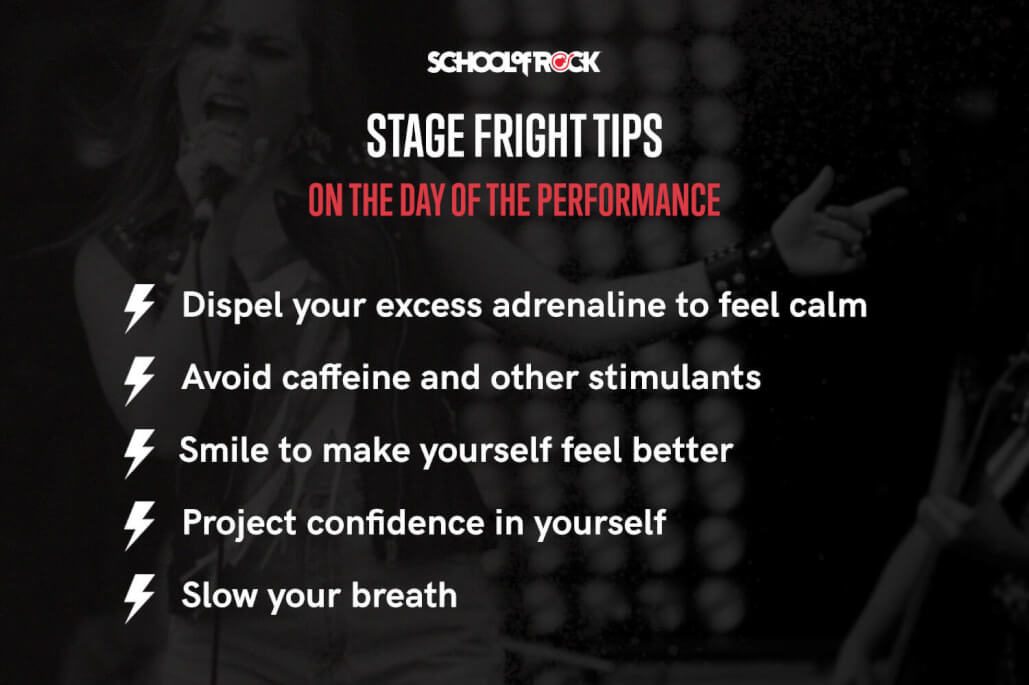
Day-of-show management: How you spend the hours before a show affects your mental state. Avoid caffeine and sugar, which can amplify the physical symptoms of anxiety. Eat a light meal two to three hours before the show. Stay hydrated. Arrive at the venue early so you are not rushed. Rushing triggers the stress response because it signals a loss of control. Give yourself time to set up, soundcheck, and transition into performance mode without hurry.
Long-Term Confidence Building
Stage fright does not disappear after one good show. It is managed through consistent practice and a long-term approach to building genuine confidence.
Tracking progress: Keep a performance journal. After each show, write down one thing that went well and one thing you want to improve. Track your anxiety level on a scale of 1 to 10 before and during the show. Over time, you will see patterns. You might notice that your anxiety is consistently lower at certain venues or that opening songs are harder than later ones. This data helps you target your preparation and also provides evidence of improvement, which builds confidence.
Performing frequently: The most effective way to reduce stage fright is to perform often. The gap between performances is when anxiety grows. The imagination fills the gap with worst-case scenarios. Frequent performances keep the experience familiar and prevent your brain from catastrophizing. If you are not booked for shows regularly, create performance opportunities. Open mics, jam sessions, busking, live streaming, or performing at senior centers and community events all count. The goal is to keep the performance muscle active.
Learning from mistakes: Every musician makes mistakes on stage. The difference between those who overcome stage fright and those who do not is how they interpret mistakes. If you interpret a wrong note as evidence that you are not good enough, anxiety increases. If you interpret the same mistake as a normal part of live performance that no one in the audience will remember in five minutes, anxiety decreases. Reframe mistakes as learning data, not as evidence of inadequacy.
Support and community: Talk to other musicians about their experience with stage fright. You will quickly discover that almost everyone deals with it. Sharing strategies normalizes the experience and provides new techniques to try. If stage fright is severe enough to prevent you from performing or causes significant distress, consider working with a therapist who specializes in performance anxiety. Cognitive behavioral therapy and exposure therapy are both highly effective for this specific type of anxiety.
Practice Plan
| Week | Focus Area | Exercise | Duration |
|---|---|---|---|
| 1 | Self-Assessment | Rate your anxiety level during the last five performances on a 1-10 scale. Identify your specific symptoms (physical, cognitive, or both) and when they peak. Write down your current coping strategies. | 30 min |
| 2 | Breathing Practice | Practice diaphragmatic breathing twice daily for five minutes. Use the 4-4-6 pattern (inhale 4, hold 4, exhale 6). Apply before every rehearsal. Rate anxiety before and after. | 10 min/day |
| 3 | Visualization Training | Spend five minutes each day visualizing a successful performance. Include sensory details: the stage lights, the crowd noise, the feel of your instrument, the first notes. Make it as vivid as possible. | 5 min/day |
| 4 | Simulated Performance | Perform your set for a small audience of 2-3 trusted friends. Practice your full pre-show routine beforehand. Focus on process goals, not perfection. Repeat three times this week. | 45 min/session |
| 5 | Public Exposure | Find a low-stakes performance opportunity: open mic, jam session, or busking. Use all techniques practiced so far (breathing, visualization, routine). Note what worked and what did not. | Varies |
| 6 | Full Integration | At your next booked show, implement your complete pre-show routine. Use breathing before going on stage. Set three process goals. After the show, journal about the experience and rate your anxiety. | Full show |
Frequently Asked Questions
Is stage fright a sign that I should not be a musician?
No. Stage fright affects musicians at every level, from beginners to world-famous artists. It is a normal physiological response to perceived threat, not a measure of talent or suitability. Many of the most celebrated performers in history have reported experiencing significant stage fright throughout their careers.