Table of Contents
Introduction
An out-of-tune guitar is the fastest way to kill your motivation. Every chord sounds wrong, every song you try to play feels off, and you cannot tell whether the problem is your fingers or the instrument. Tuning is a skill that takes five minutes to learn and a lifetime to master by ear. This guide covers standard tuning first, then explores Drop D and Open G, the two most common alternate tunings in popular music.
Key Takeaways
- Standard tuning (EADGBE) is the default for 95% of guitar music. Learn it first and learn it well.
- Drop D (DADGBE) lowers the 6th string one whole step for a heavier, deeper sound used in rock and metal.
- Open G (DGDGBD) tunes the strings to a G major chord, letting you play chords with a single finger barre.
- Always tune up to pitch, never down. If a string is sharp, drop it below pitch and bring it up. This prevents slack from building up behind the nut.
- Stretch new strings immediately. Pull each string gently away from the fretboard, retune, and repeat until it holds pitch.
Standard Tuning: EADGBE
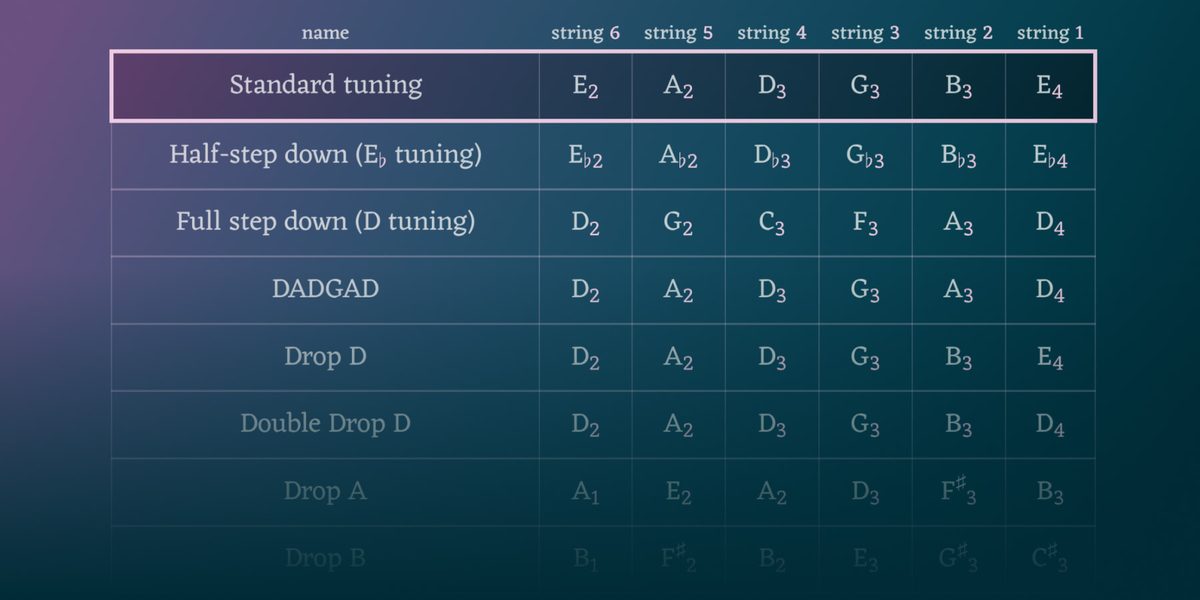
Standard tuning from the thickest string to the thinnest is E-A-D-G-B-E. A common mnemonic is "Eddie Ate Dynamite, Good Bye Eddie." The low E (6th string) is tuned to 82.41 Hz, the A (5th) to 110 Hz, D (4th) to 146.83 Hz, G (3rd) to 196 Hz, B (2nd) to 246.94 Hz, and high E (1st) to 329.63 Hz. Each string is tuned a perfect fourth apart, except the G-to-B interval, which is a major third. This irregularity is why some chord shapes shift when you cross the G string.
If you are using a clip-on tuner, attach it to the headstock, pluck the 6th string, and watch the display. Turn the tuning peg until the needle centers on E. Move to the 5th string and tune to A. Continue through all six strings. After tuning all strings, go back and check the first string again. Changing tension on one string can affect the others, especially on guitars with a floating bridge like a Stratocaster or a tremolo system. You may need two or three passes before all strings settle.
Tuning Methods: Clip-On, App, and By Ear
A clip-on tuner attaches to the headstock and senses vibration directly from the wood. It works in noisy environments because it does not rely on a microphone. The Snark SN-5X or TC Electronic Polytune Clip are reliable choices at $15 to $30. Clip-on tuners are the most accurate and convenient option for beginners. Smartphone tuner apps like Fender Tune, GuitarTuna, and Pano Tuner use your phone's microphone. They are free and accurate enough for practice but struggle in loud rooms or when other instruments are playing nearby. For practicing alone at home, a phone app is perfectly adequate.
Tuning by ear develops your musical ear and is essential when you do not have a tuner handy. The 5th-fret method is the standard approach. Press the 6th string at the 5th fret to produce an A note. Play the open 5th string and adjust its tuning peg until both notes sound the same. Repeat: 5th string, 5th fret = open 4th string. Then 4th string, 5th fret = open 3rd string. Then 3rd string, 4th fret = open 2nd string (the G-to-B interval changes the fret from 5 to 4). Finally, 2nd string, 5th fret = open 1st string. Check your work by playing a chord you know. If the chord sounds right, your ear tuning is accurate.
Drop D Tuning
Drop D tuning lowers the 6th string from E down one whole step to D. The resulting tuning is D-A-D-G-B-E. The name comes from "dropping" the low E string to D. With both the 6th and 4th strings tuned to D, you can play a power chord by barring the bottom three strings with one finger. This makes Drop D ideal for heavy rock and metal riffs.
To get into Drop D from standard, pluck the 6th string and slowly turn its tuning peg counterclockwise while watching the tuner. Stop when it reads D. You can also use the 4th string as a reference: fret the 4th string at the 7th fret (which produces a D note) and tune the 6th string until both notes match. Drop D is used in songs like "Everlong" by Foo Fighters, "Moby Dick" by Led Zeepelin, and "The Pretender" by Foo Fighters. The tuning gives you a deeper, heavier low end while keeping the rest of the guitar in standard tuning for familiar chord shapes.
Open G Tuning
Open G tuning is D-G-D-G-B-D from low to high. When you strum all six strings open, you hear a G major chord. This tuning is the foundation of blues and rock slide guitar, popularized by Keith Richards of the Rolling Stones. To get into Open G from standard, tune the 6th string down from E to D, the 5th string down from A to G, the 1st string down from E to D, and leave the 4th (D), 3rd (G), and 2nd (B) strings unchanged.
The magic of Open G is that a simple barre across any fret creates a major chord. Barre the 5th fret with your index finger and you have a C chord. Barre the 7th fret for a D chord. This makes Open G incredibly efficient for rhythm guitar, especially for blues shuffles and rock songs. The downside is that most standard chord shapes you learned no longer work. You need to learn new voicings. Keith Richards famously removes the 6th string entirely from his Open G guitars, playing with only five strings. The trade-off is worth it for the unique voice of Open G. Songs like "Start Me Up," "Honky Tonk Women," and "Brown Sugar" by the Rolling Stones all use Open G tuning.
Quick Tuning Practice Routine
| Day | Focus | Exercise |
|---|---|---|
| 1-2 | Standard tuning with clip-on tuner | Tune all 6 strings. Check with G chord. Retune. Repeat 3 times. |
| 3-4 | Standard tuning by ear (5th fret method) | Tune using reference only. Check with tuner afterward. Score yourself. |
| 5 | Drop D tuning | Standard tune first, then drop 6th string to D. Play power chords on bottom 3 strings. |
| 6 | Open G tuning | Standard tune first, then adjust 6th, 5th, and 1st strings. Barre at 5th fret. |
| 7 | Switch between all three | Standard to Drop D to Open G and back. Time yourself. Aim for under 2 minutes per change. |
Frequently Asked Questions
- How often should I tune my guitar during practice?
- Check tuning before every practice session and whenever you pick up the guitar after a break. Temperature changes alone can knock a guitar out of tune within 15 minutes. During a long session, check every 20 to 30 minutes.
- Why does my guitar go out of tune so fast?
- New strings need time to stretch. Old strings lose elasticity. Poor-quality tuning pegs slip. Strings wound improperly around the peg also slip. Try restringing carefully with at least 2 to 3 wraps around the peg post.
- Can alternate tunings damage my guitar?
- Dropping strings lower (down-tuning) does not damage the guitar. Tuning strings higher than standard creates extra tension and can warp the neck or break strings. Never tune a string more than two whole steps above its standard pitch.
- Do I need a different tuner for alternate tunings?
- No. Any chromatic tuner supports all notes across the full pitch range. Simply tune each string to the target note regardless of what tuning you are using.
- What is the fastest way to tune on stage?
- Use a clip-on tuner with a strobe display and mute the output while tuning. Practice tuning between songs so it becomes automatic. Many professionals use a Boss TU-3 pedal tuner that mutes the signal and provides high-accuracy tuning.
Conclusion
Tuning is the first skill you need and the one you will use every time you pick up a guitar. Master standard tuning with a clip-on tuner first, then develop your ear, and finally explore Drop D and Open G to expand your musical range. A well-tuned guitar makes everything you play sound better. Tune up before every session and make it a habit.
Pro Tip: Tune your guitar every time you pick it up, even if it sounded fine yesterday. Temperature and humidity changes cause strings to expand and contract, pulling them out of pitch.