Table of Contents
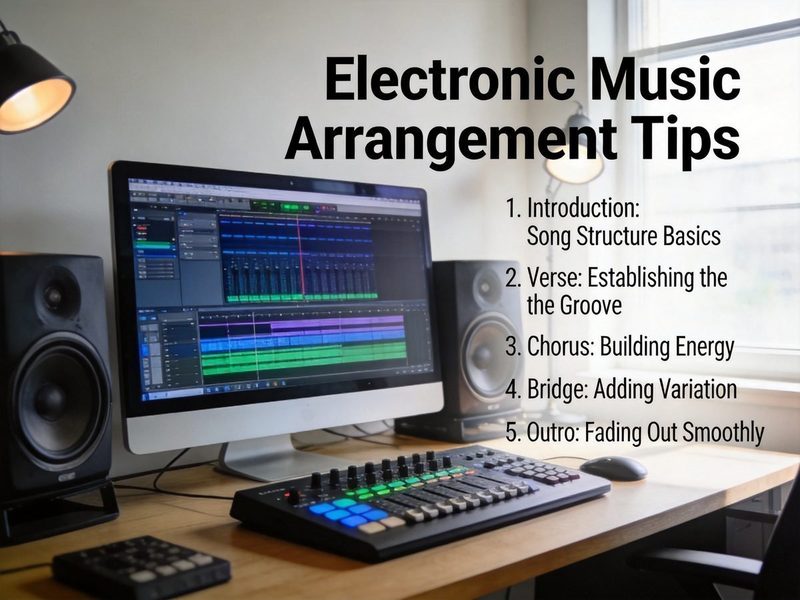
You have a great kick drum, a fat bassline, and a catchy melody. But they are stuck in an 8-bar loop and you cannot figure out how to turn them into a full track. Arrangement is the skill that separates loop makers from track finishers. This guide covers the structural framework, transition techniques, and professional arrangement strategies that turn your loops into complete songs.
Key Takeaways
- Standard structure: Intro, Build, Drop, Breakdown, Build, Drop, Outro
- Each section should be 8 to 16 bars for most electronic genres
- Use risers, filter automation, and rhythmic acceleration to build tension
- Remove the kick before a drop for maximum impact
- Automate at least three parameters per section transition
The Standard Electronic Music Structure
Most electronic music follows a predictable arrangement that has been refined over decades of club testing. Understanding this structure gives you a proven framework for your first tracks. While you can break these rules later, you need to know them first.
The standard arrangement is: Intro (8-16 bars) to Build (8-16 bars) to Drop (8-16 bars) to Breakdown (8-16 bars) to Build (8-16 bars) to Drop (16-32 bars) to Outro (8-16 bars). Total track length ranges from about 3 to 6 minutes depending on the genre. House tracks tend toward 5-7 minutes. Techno tracks can run 6-10 minutes. Dubstep and drum and bass are typically 3-5 minutes.
Energy mapping is a useful visualization technique. Draw a graph with time on the horizontal axis and energy level on the vertical axis. The line should look like a mountain range with two peaks (the two drops) and a valley in between (the breakdown). The second drop should ideally be higher energy than the first, achieved by adding elements or increasing density.
Crafting an Effective Intro
The intro is the first impression your track makes. It sets the mood, establishes the key and tempo, and prepares the listener for what is coming. A well-crafted intro makes DJs want to mix into your track and listeners want to hear more.
Start with atmosphere. An ambient pad, a filtered loop, a field recording, or a melodic phrase that hints at the main hook. The first sound should immediately establish the emotional tone. If your track is dark and driving, start with a low rumbling bass and distant percussion. If it is euphoric, start with a washed-out pad and a single piano note.
Introduce elements gradually. Do not throw everything at the listener at once. Add one element every 2 to 4 bars. A typical intro progression: atmosphere (bars 1-4), hi-hats (bars 5-8), kick with high-pass filter (bars 9-12), claps (bars 13-16). The high-pass filter on the kick is critical it lets the listener feel the rhythm without the full low-end impact, creating anticipation for when the filter opens.
Keep it DJ-friendly. The first 16 bars should be relatively sparse and not too loud. Club DJs need room to mix the incoming track over your intro. Avoid having the full drum kit or the main hook in the first 8 bars. A stripped-down intro that is 50-60 percent of the main tracks energy level is ideal for mixing.
Builds and Tension Techniques
The build is where you ramp up energy before the drop. This is the most critical section for creating emotional impact. A weak build means a weak drop, regardless of how good the drop itself sounds.
Add elements incrementally. The build should introduce new elements one at a time, each one adding energy. A typical build in house music: add a second percussion layer (shaker on eighth notes), introduce a synth stab on the off-beats, bring in a vocal chop or sample, layer a white noise riser that grows in volume.
Filter automation is the most effective build technique. Slowly open a high-pass filter on the entire track or on specific elements. As the filter cutoff rises, the sound becomes thinner and brighter, creating a sense of acceleration. The filter should reach its highest point just before the drop, at which point it snaps back to full range, creating a sudden burst of low-end power.
Rhythmic acceleration creates tension through increasing density. The hi-hats might start on quarter notes, move to eighth notes, then sixteenth notes, then thirty-second notes in the final bar. Percussion patterns become more complex and frequent. A snare roll in the last 4 bars with increasing speed is one of the most reliable build techniques across all electronic genres.
The drop moment. The most common technique is to cut the kick on the last beat before the drop. One full beat of silence before the drop hits creates maximum impact. Alternatively, a reversed cymbal crash that builds into the first beat of the drop is a classic transition. The drop itself should hit with the full drum kit, full bassline, and the main hook together.
Drops and Energy Peaks
The drop is the moment your track delivers on the promise of the build. It is the highest energy section and the part that listeners remember. A well-constructed drop makes people move.
First drop versus second drop. The first drop typically lasts 8 to 16 bars and establishes the main hook. The second drop should be longer (16-32 bars) and bigger. You can achieve this by adding an extra element (a counter-melody, a vocal hook, a more complex drum pattern), removing the bassline for 4 bars and bringing it back harder, or switching to a half-time feel for the second half of the drop.
Drop variation prevents the section from becoming repetitive. Within a 16-bar drop, vary the drum pattern every 4 bars. Change the hi-hat rhythm, add a snare fill, or bring in a breakdown element like a filtered pad. The bassline can vary as well. A common technique is to drop the bass out for 2 bars and bring it back with a fill or variation.
Energy management within the drop is critical. The highest energy moment should not be the first bar of the drop. It should be around bar 6-8 of the drop, after the listener has had time to absorb the full impact and the arrangement has built slightly further. A small drop in energy around bar 4 (removing one element for one bar) creates a micro-breath that makes the return more impactful.
Breakdowns and Emotional Moments
The breakdown is the emotional center of your track. It strips away the rhythmic elements and creates space for melody, atmosphere, and emotional connection. A great breakdown can be the most memorable part of a track.
Strip down to essentials. Remove the kick, bass, and percussion. Leave only a pad, a melodic phrase, or a vocal sample. The transition from full energy to silence should feel like a relief. Use a filtered sweep or a long reverb tail on the last elements of the drop to smooth the transition into the breakdown.
Introduce new material. The breakdown is where you introduce the emotional heart of the track. A new chord progression, a vocal hook, a piano melody, or an atmospheric texture. This material should contrast with the energy of the drop. If the drop is aggressive and driving, the breakdown should be delicate and spacious. Contrast makes both sections stronger.
Build back up. The breakdown should begin to build energy in its second half. Bring back percussion elements one at a time, starting with hi-hats. Add a bass element with a high-pass filter. Introduce a riser effect. The final 4 bars of the breakdown should clearly signal that the second drop is approaching. The transition from breakdown back to full energy is often more powerful than the initial intro-to-drop build.
Transitions and Automation
Transitions are the glue that holds your arrangement together. Without deliberate transitions, your track sounds like a series of loops arbitrarily pasted together. Professional transitions use a combination of audio effects, automation, and arrangement techniques.
Risers and falls are the most common transition effects. A white noise riser with increasing volume and pitch creates tension. A reverse cymbal builds into a downbeat. A pitch-bent synth note sliding up or down signals a change. Many DAWs include built-in riser samples or you can create your own by automating pitch, filter cutoff, and reverb on any sound.
Reverb and delay throws smooth transitions by creating a wash of sound. At the end of a section, automate the reverb wet level on your snare or lead to 100 percent. The sound trails off into a reverb tail that carries through the transition point. Cut the reverb abruptly when the next section hits for a dramatic contrast. Delay throws work similarly, with the last note of a section triggering a long delay that rings into the next section.
Filter sweeps at section boundaries blend old and new material. A low-pass filter sweep that closes at the end of a section and opens at the start of the next creates a seamless transition. Automating the cutoff frequency of a master filter or a group bus filter creates the classic whoosh sound that signals arrangement changes.
Arrangement Practice Plan
| Step | Task | Duration |
|---|---|---|
| 1 | Import a reference track into your DAW and mark its section boundaries (intro, build, drop, etc.) | 30 min |
| 2 | Create a 16-bar intro with 4 elements introduced one at a time | 45 min |
| 3 | Program an 8-bar build with filter automation and a riser effect | 30 min |
| 4 | Structure an 8-bar drop with the full arrangement (kick, bass, lead, percussion) | 45 min |
| 5 | Create an 8-bar breakdown that contrasts with the drop | 30 min |
| 6 | Arrange the full track by copying and arranging sections, adding transitions | 60 min |
Frequently Asked Questions
How long should an electronic track be?
For streaming platforms, aim for 3 to 4 minutes. For club or DJ use, 5 to 7 minutes is standard. If you are targeting both, create a shorter radio edit (3-4 min) and a longer extended mix (5-7 min). The extended mix gives DJs room to mix and the shorter edit works better for casual listeners on streaming platforms.