Table of Contents
Introduction
Fingerpicking turns the guitar into a one-person band. Your thumb plays the bass while your fingers handle melody and harmony, creating a full, layered sound that strumming alone cannot achieve. Travis picking, named after country guitarist Merle Travis, is the most influential fingerstyle technique in popular music. This guide teaches you the core fingerpicking patterns, starting with simple exercises and building up to full Travis picking.
Key Takeaways
- Your thumb owns the bass. The thumb alternates between the low E, A, and D strings, playing a steady rhythm while your fingers handle the treble strings.
- Fingers are assigned to strings. Index (i) plays G, middle (m) plays B, ring (a) plays high E. This assignment never changes.
- Travis picking is a thumb-lead pattern where the thumb plays quarter notes and fingers fill the offbeats.
- Keep a steady bass even when the melody changes. The alternating thumb is the engine that drives fingerstyle guitar.
- Short nails on the fretting hand, longer nails on the picking hand produce a clearer, more consistent tone.
Hand Position and Nail Care
Rest your picking forearm on the guitar body so your hand hovers over the soundhole or bridge. The thumb extends ahead of the fingers, roughly parallel to the strings. Curl your fingers toward your palm slightly, like holding a small ball. Your index, middle, and ring fingers should strike the strings with the flesh and nail together for a balanced tone.
The classical guitar notation for right-hand fingers is: p (thumb), i (index), m (middle), a (ring). These letters come from Spanish: pulgar, indice, medio, anular. Your pinky is rarely used in standard fingerpicking, though some players rest it on the guitar body for stability. Grow your picking-hand nails about 1 to 2 millimeters past the fingertip. File them smooth with a fine-grit file so they do not catch on the strings. If nails are not your preference, grow calluses on your fingertips instead; the tone will be warmer but less articulate.
The Alternating Thumb Bass
The alternating bass is the foundation of Travis picking. Your thumb plays the root note of the chord on the downbeat, then the fifth of the chord on the next beat, alternating back and forth. For a G chord, the thumb plays the 6th string (G root) on beat 1, then the 5th string (D, the fifth) on beat 2, then back to 6th string on beat 3, and so on.
Practice this thumb pattern alone before adding fingers. Place your thumb on the low E string and play four beats: 6th, 5th, 6th, 5th. Keep your thumb relaxed and let it bounce off each string. The motion comes from a slight rotation of the wrist, not from jabbing the thumb forward. Repeat for two minutes without stopping. Then switch to a C chord where the bass alternates between the 5th string (C root) and 4th string (G, the fifth). Finally, try a D chord where the bass alternates between the 4th string (D root) and the 3rd string (A, the fifth). Once each chord feels natural, switch between G, C, and D every four bars while maintaining the alternating thumb pattern. This exercise alone will take several practice sessions to master.
Travis Picking: Thumb-Lead Pattern
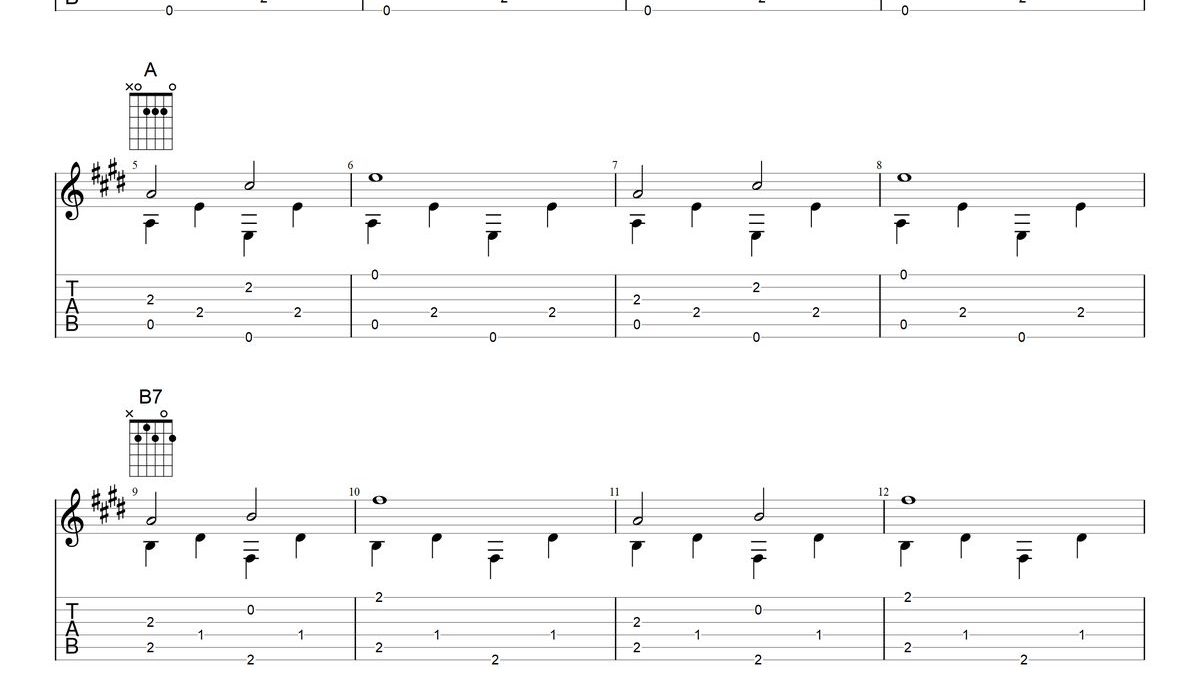
With the alternating thumb solid, add the fingers. In the basic Travis pattern, your thumb plays quarter notes on beats 1, 2, 3, and 4. Your index and middle fingers play the offbeats (the "and" counts) on the high strings. The most common pattern is: thumb (beat 1), index + middle together (offbeat 1), thumb (beat 2), index + middle together (offbeat 2), and so on.
Start on a G chord. Your thumb plays the 6th string on beats 1 and 3, and the 5th string on beats 2 and 4. On each offbeat, your index and middle fingers pluck the 2nd and 1st strings together. Count "1-and-2-and-3-and-4-and" aloud. The thumb plays on the numbers, the fingers play on the "ands." Pattern: p-pinch-p-pinch. Keep the thumb steady and independent of the fingers. This independence is the hardest skill for beginners. If the thumb speeds up or slows down when the fingers enter, drop back to thumb-only practice for another session.
Once the basic pinch pattern is comfortable, vary which strings the fingers play. On beat 1, play the 1st and 2nd strings together. On beat 2, try the 2nd and 3rd strings. Experiment with different combinations. The alternating thumb never changes, but the fingers can move freely across the treble strings.
Beyond Travis: Four Advanced Patterns
Pattern 1: Arpeggio Roll
Instead of plucking the fingers together, roll them one at a time. Over a G chord: thumb (6th string, beat 1), index (3rd string, offbeat 1), middle (2nd string, beat 2), ring (1st string, offbeat 2). The sound is a rolling harp-like effect. Practice slowly, aiming for even timing between each pluck.
Pattern 2: Bass-Melody Interplay
Play a simple melody on the high strings while the thumb keeps the alternating bass. Start with a single note on the 1st string, played by your ring finger on beat 1. The thumb plays the bass on beats 2, 3, and 4. Then the ring finger plays a melody note on beat 2 while the thumb rests. Alternate between thumb and finger melodies. This mimics a pianist playing bass in the left hand and melody in the right.
Pattern 3: Syncopated Thumb
Instead of playing the thumb on every beat, skip certain beats. Try: thumb (beat 1), rest (beat 2), thumb (beat 3), thumb (offbeat 3). The fingers fill the gaps. This syncopation creates a driving, rhythmic feel common in folk and blues. Practice with a metronome set to 70 BPM, counting the rests aloud.
Pattern 4: Cascading Harmonics
Lightly touch the 12th fret of the bass strings with your fretting hand while plucking with the thumb. The result is a bell-like harmonic that rings above the regular notes. Combine this with Travis picking: play a harmonic on the downbeat of bar 1, then return to regular thumb pattern for the rest of the measure. Harmonics add texture and dynamics to fingerstyle arrangements.
Daily Practice Plan
| Week | Focus | Exercises |
|---|---|---|
| 1 | Alternating thumb on G, C, D, Am | Thumb-only: 6-5-6-5 pattern for 5 minutes. Switch chords every 4 bars. |
| 2 | Basic Travis pinch (thumb + index/middle together) | G chord: p-pinch for 4 bars. Switch to C, then D. Metronome at 60 BPM. |
| 3 | Arpeggio roll and finger-string variety | Roll pattern on G for 2 minutes. Vary finger combinations on C and Am. |
| 4 | Bass-melody interplay | Play "twinkle twinkle" melody on 1st string while thumb keeps alternating bass. |
| 5 | Syncopated thumb patterns | Practice skipped-thumb patterns. Metronome at 70 BPM with rest counts. |
| 6 | Full song arrangement | Combine all patterns into a 3-chord song (G-C-D). Record and listen for timing. |
Frequently Asked Questions
- Do I need long nails for fingerpicking?
- Not necessarily, but nails produce a brighter, more articulate tone. If you keep your picking hand nails short, your fingertips will produce a warmer, rounder sound. Classical guitarists favor nails; folk players often use flesh only. Try both and choose what sounds better to you.
- Why does my thumb bass sound uneven?
- Uneven bass usually means your thumb is striking the strings at different angles. Keep your thumb parallel to the string and use a consistent motion. Practice the alternating thumb pattern on a single pair of strings before moving to chord changes.
- Can I use fingerpicks?
- Yes. Metal or plastic fingerpicks attach to your fingertips and produce a loud, bright tone favored by bluegrass and country players. They take some getting used to, especially the thumb pick, but they give you volume without sacrificing nail health.
- How is Travis picking different from classical fingerstyle?
- Travis picking uses a strict alternating thumb pattern with a steady bass. Classical fingerstyle allows more freedom in finger choice and rarely restricts the thumb to alternating notes. Travis picking is simpler to learn and more rhythm-driven.
- How long until I can play a full song fingerstyle?
- With 15 minutes of daily practice, most beginners can play a simple Travis-picked song within 4 to 6 weeks. Start with a slow three-chord song and focus on keeping the thumb steady rather than playing fancy finger patterns.
Conclusion
Fingerpicking transforms your guitar playing from chord accompaniment into complete musical arrangements. Start with the alternating thumb pattern, add the Travis pinch, and gradually explore the advanced patterns. Record yourself weekly to hear your progress. The secret is keeping that thumb steady while your fingers roam free. Start today with the thumb-only exercise on a G chord.
Key Stat: Travis picking uses a strict alternating thumb pattern on the bass strings while fingers handle melody on the treble strings, creating a full one-person-band sound.