Table of Contents
Introduction
Song structure is the blueprint of a musical composition. It organizes sections into a coherent narrative that guides the listener through an emotional journey. The most common structure in Western popular music is verse-chorus form, but there are many variations including AABA, through-composed, and strophic forms. Understanding song structure helps you write songs that feel complete, analyze why certain songs are memorable, and communicate effectively with other musicians during arrangement and production.
Key Takeaways
- Verse tells the story. Each verse has different lyrics but the same melody. Verses build tension toward the chorus.
- Chorus delivers the hook. Same lyrics and melody each time. The chorus is the most memorable part of the song and contains the title line.
- Bridge provides contrast. It appears once, typically after the second chorus, with new chord progressions and lyrics that offer a different perspective.
- Common structure: Intro - Verse 1 - Chorus - Verse 2 - Chorus - Bridge - Chorus - Outro. This is the standard 3-minute pop format.
- Dynamics make structure work. Each section should have a different energy level achieved through arrangement, instrumentation, and production choices.
The Building Blocks of a Song
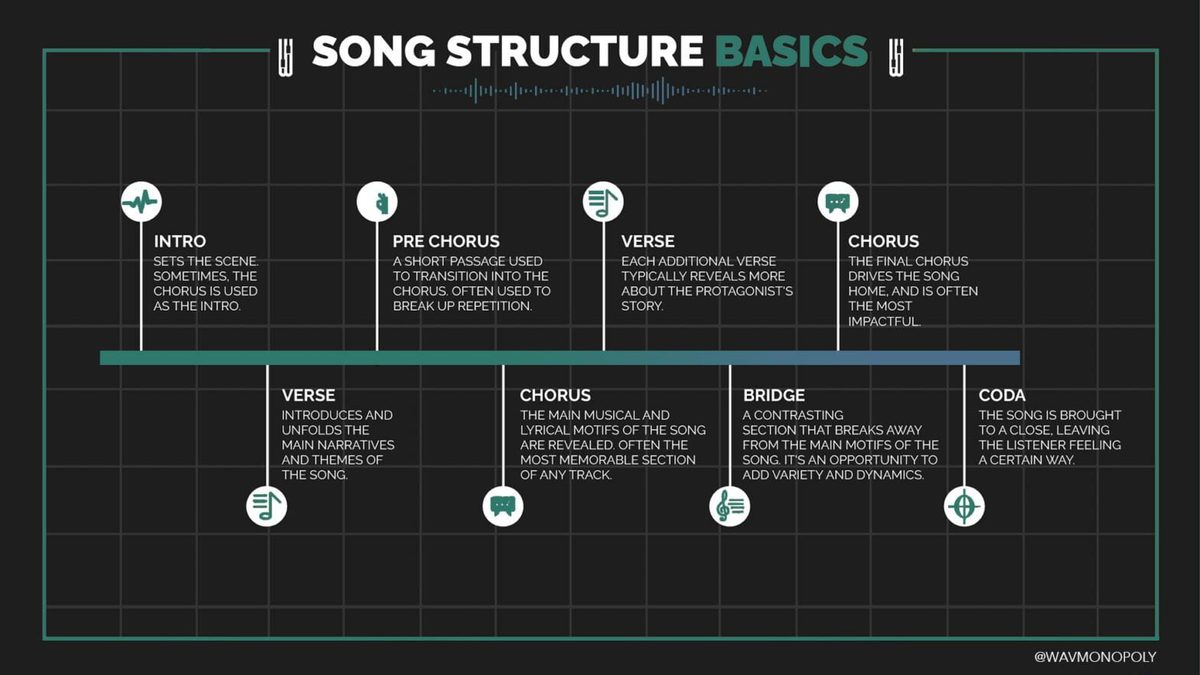
Every song section has a specific function. The intro is the first thing the listener hears; it establishes the key, tempo, and mood. Intros range from 2 to 16 bars and should hook the listener. A verse is the narrative section that tells the story. Verses typically have different lyrics each time they appear but maintain the same melody and chord progression. The melody is usually lower in pitch and less repetitive than the chorus to create contrast. The pre-chorus is a transitional section that builds tension between the verse and chorus. It typically lasts 4-8 bars and increases energy through rising melody, more frequent chord changes, and added instrumentation. The chorus is the emotional peak of the song. It contains the main hook, the title of the song, and a memorable melodic phrase that repeats each time. The chorus should be the most energetic and produced section. The bridge is a contrasting section that appears once, typically after the second chorus. It introduces new chords, a new melody, or a different lyrical perspective. The bridge provides a moment of reflection before the final chorus. The outro winds down the song, often repeating the chorus with reduced instrumentation or fading out. The solo section (guitar, keyboard, or other instrumental) typically appears after the second chorus, providing a moment of instrumental virtuosity before the bridge or final chorus.
Verse-Chorus Structure
Verse-chorus structure (also called verse-chorus form) is the dominant song structure in pop, rock, hip-hop, country, and R&B. The standard 3-minute pop song follows: Intro (4 bars) - Verse 1 (16 bars) - Chorus (8 bars) - Verse 2 (16 bars) - Chorus (8 bars) - Bridge (8 bars) - Chorus (8 bars, often double length) - Outro (4 bars). The energy should build progressively. Verse 1 starts with minimal instrumentation (vocals plus one or two instruments). The chorus enters with full instrumentation and higher vocal energy. Verse 2 adds new instrumental layers not present in Verse 1, maintaining or slightly increasing the energy. The second chorus repeats the first with possible ad-libs or vocal doubles. The bridge drops back in energy with new chords or a different groove, creating a moment of contrast. The final chorus is the biggest moment: often doubled in length, with layered vocals, additional instruments, and the highest energy. The outro provides a controlled resolution. Songs like "Rolling in the Deep" by Adele, "Blinding Lights" by The Weeknd, and "Shape of You" by Ed Sheeran all follow variations of this structure. The power of verse-chorus form lies in its balance of repetition (the predictable chorus) and novelty (new verses and bridge).
AABA (32-Bar) Form
AABA form, also known as the 32-bar song form, was the dominant structure in early to mid-20th century popular music and jazz standards. The form consists of four 8-bar sections: A (first statement), A (repeat of A), B (the bridge or release), A (return to A). The B section provides contrast, typically moving to a different key or using a different chord progression. The Beatles used AABA extensively in their early work: "Yesterday" is a perfect example. Paul McCartney's A section states the melody, the repeat of A reinforces it, the B section ("Why she had to go...") moves to a new key with emotional intensity, and the final A returns to the familiar melody. Jazz standards like "Summertime," "All the Things You Are," and "I Got Rhythm" are all AABA forms. The A section presents the main theme, the B section (often called "the middle eight") provides harmonic and melodic contrast, and the final A section resolves the tension. AABA form works well for songs with a strong melodic statement that benefits from repetition. Its limitation is that the A section appears three times, which can feel repetitive in longer songs. Modern pop rarely uses pure AABA, but it remains the standard for jazz vocalists and instrumentalists.
Variations and Hybrid Structures
Many songs use variations of standard structures to create unique listening experiences. Through-composed form has no repeated sections; each part of the song is new. This is common in art songs, progressive rock, and some forms of electronic music. "Bohemian Rhapsody" by Queen is the most famous through-composed popular song, moving through an intro, ballad, guitar solo, opera section, hard rock section, and outro without repeating any section verbatim. Strophic form repeats the same music for each verse with different lyrics. This is common in folk music, hymns, and blues. "The Weight" by The Band uses strophic form: the same instrumental backing repeats while the story unfolds through changing lyrics. Verse-chorus-bridge with a pre-chorus adds a pre-chorus between verse and chorus for extra tension. "Bad Guy" by Billie Eilish uses a short, punchy pre-chorus. Some songs add a post-chorus (an additional hook after the main chorus), like "We Will Rock You" by Queen (the stomp-stomp-clap section). Hybrid structures combine elements from multiple forms. "Someone Like You" by Adele starts with verse-chorus form and ends with a through-composed final section. Understanding standard structures gives you the foundation; breaking them intentionally creates memorable, distinctive songs.
Arrangement Techniques
Arrangement brings song structure to life. Each section needs a distinct arrangement that supports its function. Build layers progressively: intro uses one instrument, verse 1 adds two, pre-chorus adds three, chorus uses full arrangement with all instruments playing. Drop back for verse 2 by removing some layers, then rebuild to the chorus. The bridge typically strips back to a sparse arrangement (vocals plus one instrument) to create contrast. The final chorus adds everything: background vocals, extra percussion, synth pads, and any orchestral elements. Production techniques reinforce structure. Add reverb and delay to the chorus to make it sound bigger. Use a high-pass filter on the intro and gradually open it. Pan instruments wider in the chorus. Add vocal doubles or harmonies to the final chorus. Dynamics between sections should be clearly audible. The difference between verse and chorus should be 3-6dB in perceived loudness. Use space: not every section needs every instrument playing. The most powerful arrangement technique is knowing what to leave out. A verse with just vocals and piano makes the full-band chorus hit much harder.
Practice Exercises
| Exercise | Task | Goal |
|---|---|---|
| 1 | Map the structure of 5 favorite songs (label each section) | Learn to identify structural patterns |
| 2 | Write a 16-bar verse + 8-bar chorus following pop structure | Practice building sections |
| 3 | Write an 8-bar bridge with a different chord progression | Learn bridge contrast techniques |
| 4 | Create an arrangement map for a song: list instrumentation per section | Plan production dynamics |
| 5 | Rewrite a song's structure in a different form (AABA to verse-chorus) | Understand structural flexibility |
Frequently Asked Questions
- How long should each section of a song be?
- In pop music, verses are typically 8-16 bars, choruses 8 bars, pre-choruses 4-8 bars, bridges 8 bars, intros 2-8 bars, and outros 4-8 bars. Total song length: 3-4 minutes. These are guidelines, not rules. Some hit songs have 4-bar verses and 4-bar choruses.
- Can a song have multiple bridges?
- Most songs have one bridge. Multiple bridges can make the song feel structurally confused. If you want two contrasting sections, consider an instrumental solo as the first contrast and a bridge as the second.
- What is the difference between a chorus and a refrain?
- A chorus is a full section (typically 8 bars) with a complete melody and chord progression. A refrain is a short repeated line at the end of a verse, common in folk and country music. A refrain is usually 1-2 lines, while a chorus is a complete section.
- How do I know if my song structure works?
- Test it by singing through the structure without instruments: does the energy build and release in a satisfying way? Map the dynamics: each section should have a different energy level. Play it for someone unfamiliar: ask them to identify the chorus. If they cannot, the structure needs work.
- Should I follow a structure strictly or experiment?
- Learn the rules before breaking them. Write your first 10-20 songs using standard verse-chorus structure. Once you understand how and why it works, experiment with variations. The most innovative songwriters (Bowie, Radiohead, Bjork) have a deep understanding of conventional structure before subverting it.
Conclusion
Song structure provides the framework for musical storytelling. Master verse-chorus form as the foundation, explore AABA for traditional songwriting, and experiment with hybrid structures for unique results. Use arrangement techniques to differentiate each section: build layers progressively, use production effects to enhance dynamics, and trust the power of space and contrast.
Pro Tip: Test your song structure by singing through it without instruments. Map the dynamics so each section has a different energy level. If a listener cannot identify the chorus, the structure needs work.