Table of Contents
Introduction
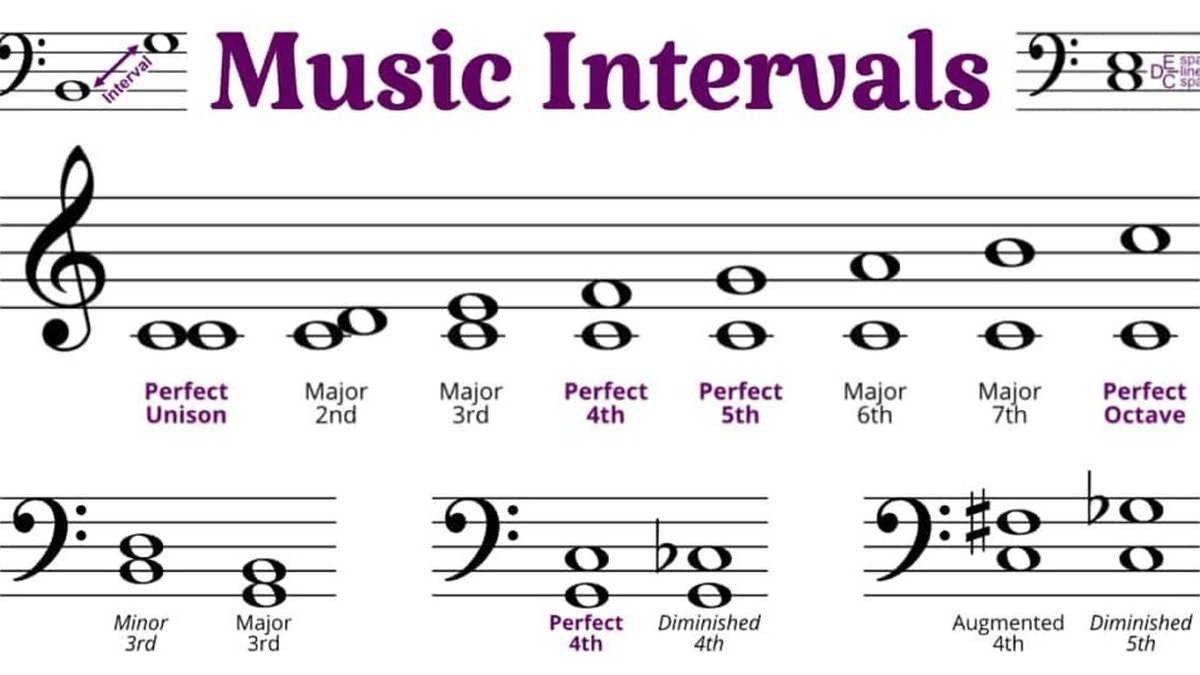
An interval is the distance between two musical notes. Understanding intervals is the foundation of music theory: scales are sequences of intervals, chords are stacks of intervals, and melodies are shaped by the intervals between successive notes. If you learn to recognize and construct intervals, you unlock the ability to build any scale, any chord, and any progression. This guide covers all intervals from unison to octave, their qualities (major, minor, perfect, diminished, augmented), and how to use them in your music.
Key Takeaways
- Interval number = the letter distance. C to E (C-D-E) is a 3rd. C to G (C-D-E-F-G) is a 5th. Count both starting and ending notes.
- Interval quality depends on the number of half steps. Major 3rd = 4 half steps, minor 3rd = 3 half steps.
- Perfect intervals (unison, 4th, 5th, octave) sound stable and consonant. They form the foundation of harmony.
- Major and minor intervals (2nds, 3rds, 6ths, 7ths) create the emotional character of chords and melodies.
- Reference songs help ear training: "Happy Birthday" starts with a major 2nd, "Here Comes the Bride" starts with a perfect 4th.
Interval Basics: Numbers and Quality
Every interval has two properties: a number and a quality. The number tells you the letter distance between the two notes. C to E spans three letter names (C-D-E), so it is a 3rd. C to G spans five letter names (C-D-E-F-G), so it is a 5th. Always count both the starting and ending note when determining the number. The quality (major, minor, perfect, diminished, augmented) tells you the exact half-step distance. On a piano keyboard, the distance of one semitone is the smallest step between two adjacent keys (including black keys). A major 3rd spans 4 semitones, while a minor 3rd spans 3 semitones. Intervals can be harmonic (both notes played simultaneously) or melodic (notes played in sequence). Harmonic intervals create chords; melodic intervals create melodies. The quality of an interval determines its emotional character: major intervals sound bright and happy, minor intervals sound sad or melancholic, perfect intervals sound open and stable, diminished intervals sound tense and unstable, and augmented intervals sound unresolved and searching.
Perfect Intervals: Unison, Fourth, Fifth, Octave
Perfect intervals are the most consonant and stable intervals in music. A perfect unison (P1) is the same note played twice, zero semitones apart. A perfect fourth (P4) spans 5 semitones, like C to F. A perfect fifth (P5) spans 7 semitones, like C to G. A perfect octave (P8) spans 12 semitones, like C to the next C. Perfect intervals get their name from the mathematical purity of their frequency ratios: 2:1 for the octave, 3:2 for the perfect fifth, 4:3 for the perfect fourth. These ratios create sounds that naturally reinforce each other. The perfect fifth is the most important interval in Western harmony. A power chord is simply a perfect fifth. The perfect fourth is slightly less stable than the fifth but still highly consonant. In chord construction, the perfect fifth is present in almost every chord (major, minor, and many extensions). The interval between the root and the fifth is always perfect unless it is specifically altered (diminished or augmented). If you flatten the fifth by one semitone, you get a diminished fifth (tritone, 6 semitones), which sounds dissonant and unstable. If you sharpen the fifth, you get an augmented fifth (8 semitones), also unstable.
Major and Minor Intervals
Seconds, thirds, sixths, and sevenths come in major and minor versions. A major second (M2) spans 2 semitones, like C to D. A minor second (m2) spans 1 semitone, like C to C-sharp. The minor second is the most dissonant interval and creates tension. A major third (M3) spans 4 semitones, like C to E. A minor third (m3) spans 3 semitones, like C to E-flat. The major third sounds bright and is the defining interval of a major chord. The minor third sounds sad and defines a minor chord. A major sixth (M6) spans 9 semitones, like C to A. A minor sixth (m6) spans 8 semitones, like C to A-flat. Sixths are relatively consonant and add color to chords. A major seventh (M7) spans 11 semitones, like C to B. A minor seventh (m7) spans 10 semitones, like C to B-flat. The major seventh has a distinctive longing quality, while the minor seventh is more bluesy and is the defining interval of a dominant seventh chord. To find the quality of any interval, count the half steps between the two notes and consult a reference chart. With practice, you will recognize common intervals instantly: a major third sounds happy, a minor third sounds sad, and a perfect fifth sounds hollow and open.
Compound Intervals
Compound intervals are larger than an octave (greater than 12 semitones). They are named by adding 7 to the simple interval number. A 9th is a 2nd plus an octave (14 semitones). A 11th is a 4th plus an octave (17 semitones). A 13th is a 6th plus an octave (21 semitones). Compound intervals appear in extended chords like Cmaj9, C11, and Cmaj13. The quality of a compound interval matches the quality of its simple version: a major 9th has the same quality as a major 2nd. In practice, compound intervals are often analyzed and named by their simple interval equivalent because the ear hears the harmonic function of the simple interval even when it spans multiple octaves. Jazz harmony uses compound intervals extensively. A Cmaj13 chord contains a major 13th (which is a major 6th plus an octave). Understanding compound intervals helps you analyze complex jazz chords and build richer voicings.
Ear Training for Intervals
Training your ear to recognize intervals is one of the most valuable skills a musician can develop. The most effective method is associating each interval with a familiar song. Perfect unison: the beginning of "We Will Rock You" (stomp-stomp-clap). Minor second: the Jaws theme. Major second: "Happy Birthday" (first two notes). Minor third: "Greensleeves" or "Hey Jude" (first two notes). Major third: "When the Saints Go Marching In" (first two notes). Perfect fourth: "Here Comes the Bride" (first two notes). Tritone (diminished fifth): the opening of "The Simpsons" theme or "Maria" from West Side Story. Perfect fifth: the Star Wars main theme or "Twinkle Twinkle Little Star" (first two notes). Minor sixth: the theme from "Love Story". Major sixth: "My Bonnie Lies Over the Ocean" (first two notes). Minor seventh: the first two notes of "Somewhere" from West Side Story. Major seventh: the first two notes of "Take On Me" by A-ha. Octave: "Somewhere Over the Rainbow" (first two notes). Practice identifying intervals daily with an ear training app like EarMaster, Perfect Ear, or Functional Ear Trainer. Start with perfect intervals and major/minor thirds, then gradually add more intervals as you gain confidence.
Practice Exercises
| Exercise | Task | Goal |
|---|---|---|
| 1 | Identify all white-key intervals from C ascending to each note | Learn interval numbers and basic qualities |
| 2 | Play and name 12 intervals from random starting notes | Practice interval construction |
| 3 | Sing each interval using reference songs | Internalize interval sounds |
| 4 | Identify 10 random intervals played on piano | Develop ear training |
| 5 | Find the interval between melody notes in a pop song | Apply intervals to real music |
Frequently Asked Questions
- What is the difference between a major and minor interval?
- A major interval is one semitone wider than its minor counterpart. For example, a major 3rd is 4 semitones, a minor 3rd is 3 semitones. Major intervals sound brighter, minor intervals sound darker or sadder.
- Why are unisons, fourths, fifths, and octaves called perfect?
- These intervals have mathematically pure frequency ratios (2:1, 3:2, 4:3) and exist in the natural harmonic series. They sound perfectly stable and consonant. Unlike major/minor intervals, perfect intervals cannot be major or minor; they are either perfect, diminished (one semitone narrower), or augmented (one semitone wider).
- What is the tritone and why is it important?
- The tritone is an interval of 6 semitones (diminished fifth or augmented fourth). It was historically called "diabolus in musica" (the devil in music) because of its dissonant, unstable sound. The tritone is crucial in dominant seventh chords and provides the tension that resolves to the tonic.
- How do intervals relate to chords?
- Chords are built by stacking intervals on top of a root note. A major chord is a root plus a major 3rd plus a perfect 5th. A minor chord is a root plus a minor 3rd plus a perfect 5th. Extended chords add 7ths, 9ths, 11ths, and 13ths on top.
- Can I learn intervals without reading music?
- Yes. Use a piano keyboard, guitar fretboard, or even a virtual instrument to play notes and measure the distance in frets or semitones. Focus on ear training by singing intervals and recognizing them in songs. You do not need standard notation to understand interval relationships.
Conclusion
Intervals are the building blocks of all music. Master the distance between two notes and you unlock scales, chords, and melody construction. Start by learning perfect intervals and major/minor thirds, practice identifying them by ear with reference songs, and apply your knowledge to chord building. With consistent ear training, interval recognition becomes second nature.
Key Stat: Intervals are the building blocks of all music. A major chord is a root plus a major 3rd and perfect 5th. A minor chord uses a minor 3rd instead of major.